
How to find your body shape and dress it well: Measure your bust, waist, and hips, then compare the ratios — not the numbers — to identify your proportion shape. Using the Proportion-First Styling Method, dress for the relationship between those three points: where your body is widest determines your silhouette strategy, not your size. For example, a pear figure builds every outfit from the shoulder down; an apple figure maintains one unbroken vertical line from shoulder to hem.

There is a woman you’ve noticed before — across a room, on a street, in a moment that made you pause. Nothing she wore was extraordinary. But everything worked. And the question stayed with you: what does she understand that I don’t? The answer is simpler than you were taught.
It’s proportion.
She knows where her body is widest. She knows how everything flows from that point. And she gets dressed without overthinking it. That is what this guide gives you. Not trends. Not rules that change next season. A system you can return to every single morning.
You are not difficult to dress. You were just given the wrong instructions.
Most style advice stops at labeling your shape. Apple. Pear. Hourglass. But knowing your shape is not the goal —
knowing what to do with it is. So instead of asking you to read everything, this guide is built differently:
Find your shape. Read its section. Everything else follows.

I need something specific right now
-
-
- Summer-to-Fall Style Guide for My Shape
- Fall Outfit Formulas for My Shape
- Summer Outfits for My Shape
- Swimwear for My Shape
- One-piece Swimsuits for My Shape
- Jeans for My Shape
- Shorts for My Shape
- Lingerie for My Shape
- Capri Pants for My Shape
- Dresses for My Shape
- Wedding Guest Dresses for My Shape
- Wedding Dresses for My Shape
- Little Black Dress Guide for My Shape
- Casual Outfits for My Shape
- Vacation Outfits for My Shape
- I’m Over 40, and This Body Shape Guide Changed How I Dress
-
I don’t know my body shape yet
Start here first How to Find Your Body Shape
I know my shape — take me straight there
- Hourglass
- Pear / Triangle
- Inverted Triangle
- Rectangle
- Apple / Round
- Oval
- Athletic / Straight
- Petite
- Plus Size
The Year-Round Fabric Guide — What to Buy and Why
Why Expensive Clothes Still Look Wrong on You
The Complete Dressing Checklist
Each body shape section covers the complete picture: outer dressing formulas and seasonal combinations, the foundation layer (lingerie, bras, and briefs), sleepwear, homewear and loungewear, office and workwear, casual dressing, events and occasion dressing, and swimwear. Every sub-section ends with a link to a dedicated deeper guide when you are ready to go further.
Step One: Find Your Body Shape
You need a soft measuring tape and three minutes. Stand naturally — no holding in, no performance. You are measuring the relationship between three points on your body, and those three points will tell you everything you need to know.
- Measurement 1 — Bust: Across the fullest point of the chest, tape parallel to the floor. Round to the nearest half inch.
- Measurement 2 — Waist: At the narrowest point of the torso, typically one to two inches above the navel. If your torso reads as continuous with no clear narrowest point, measure at the navel.
- Measurement 3 — Hips: At the fullest point of the seat and hips, usually seven to nine inches below the natural waist.
Write them down. You are looking for three things: which measurement is largest, which is smallest, and how significant the difference is between your waist and the other two. Those ratios place you in one of nine shapes.
Instead of reading across a table, move through each shape one by one. First, compare the numbers. Then, check the mirror test. The most accurate result is usually the one where both the measurements and the real-life clothing problems feel familiar.
1. Hourglass
- What the numbers show: Bust and hips are within 1–2 inches of each other, while the waist is at least 8 inches smaller than both.
- The mirror test: The body curves in symmetrically at the centre. A fitted blazer may fit the bust and hips, but consistently gap at the waist.
- → Explore the Hourglass Body Shape guide
2. Pear / Triangle
- What the numbers show: Hips are more than 2 inches wider than the shoulders and bust.
- The mirror test: The lower body is visibly fuller than the upper body. Tops usually fit easily, but bottoms often require a size up.
- → Explore the Pear / Triangle Body Shape guide
3. Inverted Triangle
- What the numbers show: Shoulders are more than 2 inches broader than the hips.
- The mirror test: The body is widest at the shoulders. Trousers tend to fit easily, while tops may pull across the back.
- → Explore the Inverted Triangle Body Shape guide
4. Rectangle
- What the numbers show: Shoulders, waist, and hips are all within 2 inches of each other.
- The mirror test: The body reads as a largely vertical line. Belts can feel purposeless, and most clothes fit without much conflict.
- → Explore the Rectangle Body Shape guide
5. Apple / Round
- What the numbers show: The shoulders are broadly similar to or wider than the hips, with the bust fuller than the hips and weight concentrated at the midsection and abdomen — which reads as the body’s widest forward point. The waist measurement typically equals or exceeds the hip measurement.
- The mirror test: The midsection and abdomen project forward as the widest point. Arms and legs are often proportionally slimmer.
- → Explore the Apple/Round Body Shape guide
6. Oval
- What the numbers show: The midsection and waist are the single widest measurement, exceeding both the bust above and the hips below. The shoulders are slightly broader than the hips, but neither dominates the silhouette.
- The mirror test: The body is widest at the full circumference of the central torso, with no natural narrowing anywhere between underbust and hip. This is not the same as apple, where the upper body is dominant and weight projects forward.
- → Explore the Oval Body Shape guide
7. Athletic Build
- What the numbers show: Shoulders and hips are roughly equal, while the waist is only 4–6 inches smaller, creating minimal curve definition.
- The mirror test: The body looks strong, lean, and straight-lined. Clothes may sit well, but frequently feel like they are doing nothing.
- → Explore the Athletic Body Shape guide
8. Petite
- What the numbers show: Petite can include any of the above proportions, at a total height of 5’3″ or under.
- The mirror test: Hems consistently hit at the wrong point. Standard sizing is too long everywhere.
- → Explore the Petite Size guide
9. Plus Size
- What the numbers show: Plus size can include any of the above proportion shapes, in size 14/16 and above. The ratio logic is identical; the fit engineering conversation is different.
- The mirror test: Standard-size pattern scaling creates fit failures — back rise, armhole depth, shoulder seam placement — that are about the pattern, not the body.
- → Explore the Plus size Body Shape guide
If your numbers fall between two shapes
One note on the figures that fall between categories: this is more common than most guides acknowledge. Many bodies sit at the edge of two shapes — hourglass and pear, rectangle and athletic, apple and oval.
If your measurements suggest two shapes, read both sections. The dressing logic of adjacent shapes overlaps in ways that are genuinely useful.

The 9 Body Shapes – Complete Guide
Each section below is designed to be a complete reference for its shape. Read your section once with care, then return to it whenever you are making a significant dressing decision — a seasonal wardrobe edit, a shopping trip, a special occasion.
The principle never changes. Only the fabrics and silhouettes shift with the season, and the seasonal translations are given in each section.
1. The Hourglass: Equal Width, Defined Waist

The telltale shopping moment: you cannot button a fitted blazer without tailoring. Whatever fits across the chest gaps at the waist. Whatever fits at the waist pulls across the chest.
The true hourglass is rarer than most women believe. Research in body proportion consistently places it at around eight percent of women. If your measurements confirm it, understand what you actually have: a figure that fashion has historically been designed to celebrate — and which requires only one rule. Acknowledge the waist. Never fight it, overdo it, or ignore it.
Your shape references across decades: Sofia Vergara, who drapes and wraps rather than cinches. Salma Hayek, who chooses fitted without tight. Beyoncé, who has built an entire aesthetic vocabulary around understanding precisely how much silhouette is enough. These are not women who chase trends. They dress one principle, consistently.
The dressing philosophy: The waist is a natural asset. The goal is not to make it the sole point of every outfit. It is to acknowledge it with intention, then let the fabric do the rest. The line between a figure that looks dressed and one that looks overdressed often comes down to whether the waist is being declared or merely accommodated.

Fabrics — what works and why
- Always: Jersey, fluid knit, silk, cupro, stretch crepe — fabrics that follow the body’s movement without adding bulk at the curves. These drape rather than sit.
- Seasonal: Ponte and lightweight wool for cooler months — structured enough to hold shape with enough give to accommodate the waist-to-hip difference without pulling.
- Avoid: Stiff canvas, heavy non-stretch denim — they gap at the waist and pull at the hip simultaneously, which is the defining fit problem of this shape.

Three moves that work in every season
- The half-tuck. One corner of a blouse tucked in, the rest falling loose, with a straight-leg trouser. It reads as considered, slightly undone, entirely French. It acknowledges the waist without making the waist the entire point. This works in linen in summer, in a silk blouse in autumn, in a fine knit in winter.
- Buy for the hips, tailor for the waist. A trouser that fits the hip will almost always gap at the waist. One alteration — taking in the waistband — costs under thirty dollars and transforms every pair you own. This is the hourglass figure’s single most valuable investment, and it is made once per garment, not once per season.
- The wrap silhouette. A wrap dress or wrap blouse crosses at exactly the natural waist and ties there, which means the garment finds the waist regardless of how it is cut. It is the most forgiving silhouette this shape owns, and it translates across every season: a silk wrap dress in summer, a jersey wrap in autumn and winter, a linen or cotton version in spring.
The year-round outfit formula — hourglass

Spring & Summer
- Wrap midi dress in washed silk or cupro
- High-waisted linen wide-leg + tucked silk camisole
- Belted shirt dress in cotton poplin
- Fitted jersey top + wide-leg trouser, belt loosely tied
Autumn & Winter
- Wrap knit dress in medium-weight jersey
- High-waisted tailored trouser + fitted turtleneck
- Belted wool coat worn over slim trousers
- Stretch crepe trousers + fitted blazer, open and belted
How to dress your hourglass figure — every occasion
The one principle that holds across every context, from what you wear to bed to what you wear to a black-tie event: the waist is always the reference point. Not always the focal point. Always the reference. Everything else — fabric, silhouette, proportion — is built around that single decision.
At home

Lingerie and bras, Hourglass
The hourglass figure has a structural reality that most lingerie guides ignore: the difference between your cup size and your band size is significant, and standard sizing rarely accounts for it cleanly. A bra that fits the cup but digs at the band, or fits the band but gaps at the cup, pulls every fitted garment worn over it out of alignment.
- The bra principle: An underwire style with side support keeps the bust lifted and contained without adding bulk. Side spillage — any fabric or breast tissue pushed outside the cup — creates an uneven line under fitted jersey or silk that no amount of adjusting will correct. One well-fitted underwire in a nude-to-you tone is worth more to your wardrobe than six pretty bras that do not fit correctly.
- Brief cut: A high-cut brief or Brazilian style worn at the natural hip hollow keeps the line clean under fluid trousers and wrap dresses. A full brief sitting at mid-hip creates a horizontal line across the fullest part of the seat, visible under anything that drapes.
- The one investment: Get professionally measured once. Not at a fast fashion retailer. At a specialist fitter. The difference in how your clothes sit afterward is not subtle.
For a complete guide to bra fitting, lingerie fabrics, and the specific styles that work for the hourglass figure at every price point, the full guide is here: Lingerie Guide for the Hourglass Figure
Sleepwear, Hourglass
The same proportion logic applies. A sleepwear set that acknowledges the waist — even loosely, even at home — will feel more comfortable and more considered than one that ignores it entirely.

- What works: A short wrap robe in modal or silk. A cami-and-short set where the camisole has a built-in shelf bra and sits at the natural waist rather than the hip. A nightgown in a fluid fabric with a slight gather or tie at the waist.
- What disrupts: An oversized sleep shirt worn with no waist reference at all reads shapeless rather than relaxed on this figure. If comfort is the goal, a loose top works better when paired with a fitted bottom — shorts or leggings — to preserve some sense of proportion.
- Fabric first: Modal and Tencel are the most comfortable sleepwear fabrics for curves because they move with the body without clinging or riding up. Avoid stiff cotton poplin for anything fitted — it pulls at the hip seam through the night.
Homewear and loungewear, Hourglass
Homewear is where most women abandon the principles that make them feel good in their outer wardrobe, and then wonder why they feel slightly off all day. The solution is not to dress formally at home. It is to apply the same one rule: acknowledge the waist, even loosely.

- The formula at home: A relaxed wide-leg lounge trouser in a fluid fabric, worn with a fitted or half-tucked top. Or a wrap lounge set — increasingly available at every price point — that gives the waist a soft reference without any structure. These read as genuinely comfortable and genuinely considered at the same time.
- What to avoid: A matching oversized hoodie-and-jogger set in a heavy cotton blend. On an hourglass figure this erases every proportion that outer dressing works to acknowledge. If you love the comfort of that combination, choose a cropped hoodie rather than a full-length one — it restores the waist reference without sacrificing anything.
- The upgrade worth making: One well-made lounge set in a quality fabric — a ribbed knit, a brushed modal, a washed linen — worn consistently at home does more for how you feel in your own body than any amount of outer wardrobe refinement. Comfort and proportion are not in opposition.

Outside the house
Office and workwear, Hourglass
The hourglass figure in a professional context faces one recurring tension: the clothes that fit the body well can read as too overtly shaped for certain workplace cultures. The resolution is not to dress against the figure. It is to choose the level of waist acknowledgment deliberately, based on the room.

- The workwear formula: A tailored trouser bought for the hip and altered at the waist, worn with a fitted but not tight blouse, open one button lower than seems strictly necessary, and a blazer worn open. The blazer open over a fitted top is the most useful silhouette this shape has for professional dressing — it frames the waist without announcing it.
- The dress option: A sheath dress in stretch crepe or ponte, cut to the knee, with a structured jacket or blazer over it. The jacket does the professional work; the dress underneath does the proportion work. Together they read as completely appropriate and entirely considered.
- The one rule for workwear: Fitted is professional. Tight is not. The difference lives in the fabric — stretch crepe reads fitted and composed; a bodycon knit reads tight regardless of the context. Know which one you are wearing before you leave the house.
For a complete office dressing guide for the hourglass figure, including capsule workwear recommendations and the specific alterations worth making to standard suiting: Office Style Guide for the Hourglass Figure
Casual dressing, Hourglass
Casual dressing is where the hourglass figure has the most freedom and, paradoxically, makes the most errors. The absence of occasion-dressing rules can lead to two opposite mistakes: over-thinking it into formality, or abandoning proportion entirely into shapelessness.

- The casual formula: Straight-leg or wide-leg jeans worn at the true waist, with a half-tucked tee or a fitted knit. This combination requires nothing — no belt, no blazer, no accessories — to look completely put-together. The half-tuck does the waist work; the straight leg balances the hip.
- The weekend uniform: High-waisted straight-leg denim + a fine ribbed knit tucked at the front + a clean white sneaker or loafer. Three pieces. One principle. Works in every season with fabric and colour adjustments.
- What casual dressing is not: Low-rise jeans with a cropped top, unless the cropped top sits precisely at the natural waist. Low rise on an hourglass figure cuts the torso at the hip, losing the waist entirely and widening the visual mid-section. The crop works; the low rise does not.
For a complete casual wardrobe guide for the hourglass figure, including denim recommendations and the specific casual pieces worth investing in: Casual Style Guide for the Hourglass Figure
Events and occasion dressing, Hourglass
The hourglass figure is the silhouette that formal and occasion dressing has historically been designed around, which creates a specific risk: over-dressing the shape. Every red carpet, every formal collection, every occasion dress on the market will appear to be made for this figure. Some of them are doing too much.

- The occasion principle: One point of drama. The dress can be fitted, or it can be embellished, or it can be dramatically cut — but not all three simultaneously. An hourglass figure in a heavily beaded, extremely fitted, dramatically low-cut gown is not dressed with intention. It is dressed with everything at once, which is always less powerful than one considered choice.
- What works for formal occasions: A column gown in a fluid fabric with a subtle waist seam. A wrap dress in a luxurious fabric — crepe, silk charmeuse, velvet — worn to the floor. A structured cocktail dress with a defined waist and a full skirt that falls below the knee, which balances the hip and creates a silhouette that reads as completely classic.
- The cocktail formula: Fitted bodice + defined waist + skirt that has movement. Midi length is the most flattering for this shape at most events — it balances the curve without the formality of floor length and without the exposure of a short dress that can tip the proportion.
- Insider tip: For black tie specifically, a wide-leg palazzo trouser in a luxurious fabric worn with a fitted, jewel-neck top is more sophisticated on this figure than most gowns. It acknowledges the waist through the tuck and the trouser’s high rise, then lets the fabric do the drama. Diane von Furstenberg understood this before almost anyone: that a woman dressed with intention and a clear waist reference is always the most striking person in the room, regardless of how much or how little she is wearing.
For a complete occasion and event dressing guide for the hourglass figure, including specific dress silhouettes for weddings, galas, and cocktail events: Event and Occasion Dressing Guide for the Hourglass body shape
Swimwear, Hourglass
Everything that applies to your outer wardrobe applies at the pool or beach, and more directly. The waist is your strongest visual asset in a swimsuit. The goal remains the same: acknowledge it without over-engineering the acknowledgment.

- The silhouette that works consistently: A one-piece with a defined waist — through ruching at the centre, a wrap front, or a cutout that sits precisely at the narrowest point. The fabric should follow the body, not sit away from it.
- Two-piece logic: A structured underwire or banded bikini top keeps the bust supported. A high-waisted bottom worn at the true waist frames the waist-to-hip curve rather than interrupting it mid-way. String ties work only when they sit at the natural waist hollow — if they migrate to the hip, the proportion shifts entirely.
- What disrupts the silhouette: A bandeau top with no support on a fuller bust. Bottoms worn low on the hip with a cropped top, which cuts the torso at its widest point and loses the waist. Busy prints concentrated at the hip when balance is the goal.
For a complete swimwear guide for the hourglass figure, including the specific one-piece and bikini silhouettes worth buying and the brands that cut for this shape: Swimwear Guide for Your Body Shape
Wear this today — hourglass
- Wear: Any wrap silhouette, a belted blazer, or a half-tucked blouse with a high-waisted bottom
- Avoid: Drop-waist dresses, boxy tops with no waist reference, stiff denim without stretch
- Fast fix: Add a thin belt, worn loosely at the natural waist, over whatever you are already wearing. It costs nothing and reads immediately.
- Foundation fix: If a fitted top is reading uneven across the chest or pulling at the hip, the issue is almost always the bra, not the top. Get measured before you go back to the shop.
2. The Pear / Triangle: Fuller Hip, Narrower Shoulder

The telltale moment: you find a dress you love, try it on, and it fits perfectly from the waist up. Then you try to pull it over your hips.
The pear shape is one of the most common female proportions and also one of the most served by fashion — when the right strategy is applied. Jennifer Lopez has spent three decades working this figure to its absolute maximum. The principle is singular and consistent: make the top the focal point, and let everything below it be elegant, dark, and uncluttered.

The dressing philosophy: The eye follows attention. Build your outfit from the shoulder line down. Make the top interesting — structured, detailed, textured, bright. Make everything below it simple, quiet, and uninterrupted.
This is not about hiding the hip. It is about directing where the viewer looks first. Those are very different instructions, and the difference between them is the difference between dressing defensively and dressing with authority.
Dawnn Karen, the fashion psychologist and author of Dress Your Best Life, has documented that the clothes chosen in the morning measurably affect not just how others perceive you but how you perceive yourself. The woman who builds her outfit from a position of confidence — choosing what to emphasise rather than what to conceal — dresses differently, and the result reads differently.

Fabrics for Pear shape — what works and why
- Above the waist: Crisp cotton poplin, thick linen, textured boucle, lightweight structured wool — fabrics that hold shape and create visual breadth at the shoulder.
- Below the waist: Soft viscose, silk, lightweight crepe, fluid jersey — fabrics that drape away from the hip rather than mapping it or adding structural volume to it.
- Avoid below: Horizontal stripes, thick structured denim without stretch, large static prints placed directly at hip level, cargo-style pockets at the widest point.

Three moves that work in every season
- The shoulder-first rule. Always build from the top down. Choose the top first, make it interesting, structured, or detailed, and everything below should be clean, simple, and in a quieter colour. Rihanna does this instinctively: a statement jacket or structured top, dark simple bottom. The proportions are correct every single time.
- Dark monochrome below, light or colour above. A dark trouser or skirt in one unbroken tone reads as a single shape — elegant, long, contained. A bright or textured top above it draws the eye upward. This is the pear figure’s single most reliable proportion strategy, and it works across every occasion and every price point.
- The structured tote at the shoulder. A bag worn at shoulder level — not crossbody at the hip, not carried by hand — sits at the upper body and visually reinforces the shoulder line. Small detail. Significant effect.
The year-round outfit formula — pear / triangle

Spring & Summer
- Wide-leg navy linen + crisp white poplin blouse
- A-line midi in fluid floral + structured blazer above
- Dark straight-leg jeans + boucle or textured crop jacket
- Black wide-leg trousers + bright or printed top
Autumn & Winter
- Dark straight-leg trousers + chunky knit or textured sweater
- Black midi skirt + statement coat with shoulder detail
- Dark jeans + structured blazer in a rich colour or texture
- Fluid dark skirt + embellished or printed blouse
How to dress your pear figure — every occasion
The principle that holds across every context, from what you wear at home to what you wear to a formal event, is the same one that governs your outer wardrobe: build upward. Draw attention to the shoulder line and the upper body. Let everything below be quiet, fluid, and uninterrupted. The occasion changes the fabric and the formality. The principle never changes.
At home

Lingerie and bras, Pear
The pear figure’s upper body is narrower than the hip, which means the bra situation is structurally different from other shapes. Cup sizes tend to run smaller relative to band size, and standard sizing frequently overestimates the cup needed. A bra that gaps at the cup adds the appearance of width to an upper body that benefits from definition, not volume.

- The bra principle: A lightly padded or lightly contoured underwire adds gentle definition to the bust without bulk, which helps visually balance the narrower upper body against the fuller hip. A push-up bra on a narrower chest tends to create an unnatural lift that sits uncomfortably under fitted tops. The goal is a smooth, rounded shape — present and defined, not amplified.
- Brief cut: For the pear figure, the brief choice matters more than for most shapes because it directly affects how the hip reads under clothing. A full brief in a smooth, seamless fabric worn at the natural waist is the cleanest option — it contains without compressing and sits above the widest hip point rather than across it. Avoid lace-edged styles at the hip line: the texture creates a visible ridge under fluid fabrics that no amount of smoothing will resolve.
- The one investment: A seamless, smooth brief in a nude-to-you tone in a high-quality microfiber. The difference between a cheap brief and a well-made one is entirely visible under the fluid, draping fabrics that work best for this shape below the waist.
For a complete guide to bra fitting, lingerie styles, and the specific cuts that work for the pear figure at every price point: Lingerie Guide & Shapewear for Pear Body Shape

Sleepwear
At home, the pear figure has the most freedom — and the most to gain from applying one simple principle even in relaxed dressing. A sleepwear set that adds some interest or detail to the upper body, even loosely, will feel more balanced and more comfortable than one that ignores proportion entirely.

- What works: A cami-and-short set where the camisole has a lace trim, a gathered neckline, or a delicate strap detail at the shoulder. A short wrap robe in modal or silk that crosses and ties above the waist. A printed or textured sleep top paired with plain dark or neutral shorts or bottoms.
- What disrupts: A plain oversized sleep shirt with no upper body interest worn with printed or patterned shorts — this reverses the proportion principle entirely, putting the visual weight exactly where this figure does not need it. Keep any print or pattern above the waist, or keep both pieces plain.
- Fabric first: Modal and Tencel for bottoms — they drape rather than cling at the hip. A slightly more structured or textured fabric at the top, even just a cotton with a subtle weave or a satin with a sheen, adds the gentle upper-body interest that keeps the proportions feeling right even at rest.

Homewear and loungewear, Pear
The pear figure in loungewear faces the same challenge as in outer dressing, concentrated. Most loungewear sets are designed as matching top-and-bottom in the same fabric, colour, and weight — which means the eye has nothing to follow and lands, by default, at the widest point.

- The formula at home: A ribbed knit lounge set where the top has a fitted or slightly cropped cut and the bottom is a wide-leg or straight-leg trouser in a plain, darker tone. Or a printed or textured top with plain, fluid wide-leg bottoms. The upper body carries the interest; the lower half is quiet.
- What to avoid: A matching oversized set in a single mid-tone colour with no waist definition. On a pear figure this creates an unbroken column of fabric that reads wider than it is because there is no visual anchor at the shoulder or waist to give the eye a reference point.
- The upgrade worth making: A well-made lounge set where the top and bottom are intentionally mismatched — a textured or printed top with a plain wide-leg bottom in a complementary darker tone. This requires no more effort than a matching set and applies the proportion principle automatically, every time you put it on.
Outside the house
Office and workwear, Pear
Professional dressing for the pear figure is one of the clearest applications of the shoulder-first principle. The workplace rewards a structured, composed upper body. A well-chosen blazer on a pear figure does more work than almost any other single garment in the wardrobe — it adds shoulder structure, creates upper-body presence, and frames the waist, all in one piece.

- The workwear formula: A structured blazer in a solid colour or fine texture, worn over a fitted or tucked blouse, with dark tailored trousers or a fluid midi skirt below. The blazer is doing the proportion work. Everything underneath and below it can be simple.
- The trouser rule: Buy for the hip, alter the waist. A tailored trouser that fits the hip will gap at the waist on a pear figure. One alteration — taking in the waistband — costs under thirty dollars and is the difference between a trouser that fits and one that looks like it was chosen without thought. This single habit transforms every pair of work trousers you own.
- The dress option: A wrap dress or a fit-and-flare dress with a defined waist and a skirt that starts its flare from the hip rather than the waist — this silhouette distributes the visual volume of the hip into the skirt rather than emphasising it. In a dark, solid fabric for the office it reads as entirely professional and entirely considered.
For a complete office dressing guide for the pear figure, including capsule workwear pieces and the specific blazer cuts worth investing in: Office Style Guide for the Pear Figure
Casual dressing, Pear
Casual dressing is where the pear figure makes the most consistent errors — not because the principle is complicated, but because casual contexts invite the body to default to whatever is easiest to pull on. Easiest is usually a matching set or a straight-cut dress. Neither applies the principle.

Difference Isn’t Expensive Clothes—It’s Understanding Balance and Visual Proportion
- The casual formula: Dark straight-leg or wide-leg jeans worn at the true waist, with a structured, textured, or printed top tucked at the front or worn slightly cropped. White sneakers or clean loafers below. The top is doing all the work. The bottom is simply present and proportionate.
- The weekend uniform: Dark straight-leg denim + a boucle, textured, or brightly coloured knit + a shoulder bag. Three pieces. One principle. Readable at a distance, considered up close, appropriate for every casual occasion from coffee to a weekend afternoon.
- What casual dressing is not: A plain fitted tee with leggings or casual trousers where both pieces are the same mid-tone and neither has any upper-body interest. This is the combination that feels comfortable and reads as unintentional. Add one piece of upper-body interest — a structured overshirt, a textured layer, a printed top — and the proportion corrects immediately.
For a complete casual wardrobe guide for the pear figure, including the denim cuts that work and the specific casual pieces worth having: Casual Style Guide for the Pear Figure
Events and occasion dressing, Pear
Occasion dressing for the pear figure is where the shoulder-first principle pays its highest dividend. A formal context gives you permission to use structure, embellishment, and drama at the upper body in a way that casual dressing does not — and on a pear figure, that permission is worth using.

- The occasion principle: All the drama lives above the waist. An embellished neckline, a structured or statement sleeve, a boldly coloured or textured bodice — one of these, paired with a clean, fluid, dark or neutral skirt below. The contrast between an expressive upper body and a quiet lower half is the most sophisticated proportion strategy this figure has, and it translates directly to formal dressing.
- What works for formal occasions: A fit-and-flare gown where the bodice is structured or detailed and the skirt falls in a clean A-line from the hip. A two-piece with an embellished or textured top and a fluid wide-leg trouser in a matching or complementary dark tone. A wrap dress in a luxurious fabric — silk charmeuse, crepe, velvet — where the wrap creates waist definition and the skirt falls away cleanly from the hip.
- The cocktail formula: Structured or embellished bodice + defined waist + A-line or fluid midi skirt. The skirt length matters: knee-length on a pear figure can emphasise the widest hip point; midi length falls below it and reads as more elegant and more proportionate at almost every occasion.
- Insider tip: For black tie, a wide-leg palazzo trouser in a luxurious fabric — silk, crepe, velvet — worn with a heavily embellished or dramatically structured top is more striking on a pear figure than most gowns. It keeps the lower half quiet and long while letting the upper body carry the full weight of the occasion. Yves Saint Laurent understood this: the woman in a beautifully made trouser and a considered top is always more interesting than the woman in the obvious dress.
For a complete occasion and event dressing guide for the pear figure, including specific silhouettes for weddings, galas, and cocktail events: Event and Occasion Dressing Guide for the Pear Figure
Swimwear, Pear
The shoulder-first principle applies at the beach and pool with the same clarity it applies everywhere else. The goal is to draw visual attention to the upper body and let the lower half be present without emphasis. In swimwear, this is achieved through the top choice first, the bottom choice second.

- The top that works: A bikini top with ruffles, a bandeau with a structured or textured front, an underwire halter that lifts and defines the bust, or a one-shoulder style that adds visual width at the shoulder line. Any detail, texture, or structural interest at the top half does the proportion work without any effort from the wearer.
- The bottom logic: A plain, dark, or mid-tone bikini bottom in a classic cut — high-waisted for the most flattering proportion, or a standard brief cut with no embellishment, frill, or side-tie detail at the hip. Side ties worn in a bow at the widest hip point add visual volume exactly where this figure does not need it. Tie them at the side seam flat, or choose a style without ties entirely.
- One-piece options: A one-piece with an interesting neckline — a halter, a sweetheart, a one-shoulder — and a plain, clean lower half. A swimsuit with ruching or gathering at the waist that releases into a plain lower section. Avoid a one-piece with all the design detail concentrated at the hip or lower torso.
For a complete swimwear guide for the pear figure, including the specific bikini and one-piece silhouettes worth buying and the brands that cut swimwear with this proportion in mind: Swimwear Guide for the Pear Figure
Wear this today — pear / triangle
- Wear: A structured or detailed top with dark, simple trousers or a fluid A-line skirt
- Avoid: Cargo trousers, wide horizontal stripes below the waist, anything that adds volume at the hip
- Fast fix: Move your bag to your shoulder. If it currently sits at your hip or hand, reposition it and watch the difference in a full-length mirror.
- Foundation fix: If fluid trousers or skirts are creating a visible line at the hip, the issue is almost always the brief cut. Switch to a seamless, smooth microfiber style worn at the natural waist and check the difference before changing the garment.
3. The Inverted Triangle: Broader Shoulder, Narrower Hip

The telltale moment: you put on a structured blazer and look broader than you feel. The garment is doing what it was designed to do. The problem is that your shoulder is already providing everything the shoulder pad was meant to add.
Your shape references: Angelina Jolie, Naomi Campbell, Demi Moore. Long, strong shoulders, lean hips. A silhouette that reads as powerful. The dressing goal is balance, not reduction. The inverted triangle is not a problem to solve. It is a set of proportions to work with.
The dressing philosophy: Create presence below. Keep everything above the waist soft, draped, and simple. Everything below should introduce volume, movement, or visual width. You are balancing the triangle from the bottom — not fighting it from the top.

Fabrics for Inverted Triangle — what works and why
- Above the waist: Silk, lightweight jersey, fine linen, chiffon — fabrics that fall from the shoulder without reinforcing or widening it structurally.
- Below the waist: Heavy linen, taffeta, thick cotton, structured A-line fabrics that hold themselves away from the body and create hip-level visual presence.
- Avoid above: Stiff, padded, or horizontally patterned fabrics at the shoulder — they amplify width that is already the figure’s dominant reading.

Three moves that work in every season
- The V-neck is your default. Every top, every blouse, every sweater — choose the V-neck version wherever possible. It draws the eye inward and downward from the shoulder’s widest edge, creating a vertical line that immediately softens the breadth. Angelina Jolie defaults to this neckline in almost every casual appearance, and it is not accidental.
- Volume below, always. A full midi skirt, a wide-leg trouser, a pleated skirt in any season — any silhouette that creates hip-level presence balances the shoulder width above. Naomi Campbell’s off-duty looks are a consistent lesson: simple top, wide trouser, the proportion always resolving below the waist.
- Raglan and dolman sleeves. These styles run the seam from neck to underarm rather than across the shoulder, which means the shoulder’s edge is never defined by the garment. The figure reads as softer without changing a single measurement.

The year-round outfit formula — inverted triangle
Spring & Summer
- Wide-leg linen in warm sand + silk V-neck blouse
- Full A-line midi in floral + fitted V-neck tee
- Wide-leg jeans + draped wrap or V-neck blouse
- Pleated midi skirt + simple jersey V-neck
Autumn & Winter
- Wide-leg wool trousers + fine V-neck knit
- Full midi skirt in heavy fabric + simple drape top
- Flared jeans + soft, unstructured sweater
- A-line coat (flared below hip) + slim V-neck beneath

How to dress your inverted triangle figure — every occasion
The principle that holds across every context is the one that governs everything above: keep the upper body soft and unstructured, build presence and interest below the waist. In a formal gown or a lounge set, the logic is identical. The occasion changes the fabric and the scale. The direction of attention never changes.
At home
Lingerie and bras, Inverted Triangle
The inverted triangle figure often has a fuller bust relative to the hip, which creates a specific bra challenge: finding a style that supports without adding any further width or lift at the shoulder line. A bra with thick, rigid straps or heavy padding sits high on the chest and reinforces the breadth that outer dressing is working to soften.
- The bra principle: A smooth, lightly lined underwire with narrow straps and no padding beyond a thin cup lining is the most useful style for this figure. It supports the bust without lifting it into the chest’s upper half, which keeps the shoulder-to-bust line clean and uncluttered under V-neck and draped tops. Avoid balconette styles: they widen the bust horizontally and sit high on the chest, exactly where this figure does not need additional visual width.
- Strap placement matters: Wide-set straps that sit close to the shoulder’s outer edge reinforce the shoulder’s width every time a top slips or sits off-centre. A bra with straps set slightly closer to centre keeps the line softer. Convertible styles with a racerback option are worth having — they pull the straps inward and away from the shoulder’s edge entirely, which reads cleanly under draped or soft-shouldered tops.
- Brief cut: For the inverted triangle, the brief choice is genuinely freeing. Because the hip is narrower, almost every cut works. A high-cut brief or a Brazilian style adds a small amount of visual curve at the hip, which works with the figure’s proportion goals rather than against them. Choose slightly fuller coverage over minimal — it adds the gentle hip presence that this figure benefits from.
For a complete guide to bra fitting for fuller busts, lingerie styles that work for the inverted triangle figure, and specific recommendations at every price point: Lingerie Guide for the Inverted Triangle Figure

Sleepwear, Inverted Triangle
At home, the inverted triangle figure has the most latitude of any shape in sleepwear — the narrower hip means almost every cut reads cleanly below the waist, and the softer, more relaxed fabrics of sleepwear naturally do the softening work at the shoulder that structured outer dressing has to work harder to achieve.
- What works: A short or long sleep shirt in a soft, fluid fabric — modal, washed cotton, silk — worn loose. The absence of structure at the shoulder is itself the correct choice. A cami-and-short set where the camisole has thin straps set close to centre rather than at the outer shoulder. A lightweight wrap robe in a fluid fabric that falls from the shoulder without sitting on it.
- What to avoid: A structured sleep shirt with a stiff, defined shoulder seam — even in sleepwear, a sharp set-in sleeve sitting at the outermost point of the shoulder reads as wider than the figure needs. Raglan or kimono-cut sleepwear, where the sleeve runs from the neck to the underarm, is the most comfortable and the most proportionate option for this shape.
- Fabric first: Any soft, fluid fabric works well. The specific thing to seek is weight at the hem rather than at the shoulder — a sleep shirt or nightgown with a slightly heavier hem, a lace trim at the bottom, or any detail that draws the eye downward applies the proportion principle even in bed.

Homewear and loungewear, Inverted Triangle
Loungewear is where the inverted triangle figure has a genuine advantage. The narrow hip means wide-leg lounge trousers, full lounge skirts, and voluminous bottoms — the exact silhouettes that create the most comfortable at-home dressing — are also the most proportionate choices for this shape. Comfort and proportion are, for once, entirely aligned.
- The formula at home: A wide-leg lounge trouser in a fluid fabric — brushed modal, ribbed knit, washed linen — worn with a simple V-neck or scoop-neck top in a soft jersey or fine knit. The trouser creates the hip-level presence; the top stays soft and unstructured above. This combination is genuinely comfortable, applies the proportion principle automatically, and requires no thought to assemble.
- What to avoid: A matching set where both pieces are fitted and the top has any structured or defined shoulder seam. On this figure, a fitted top and fitted bottom with a sharp shoulder line reads as the widest version of the silhouette. Choose a soft top and a wide or relaxed bottom, even in a matching set.
- The upgrade worth making: A wide-leg lounge set in a quality fabric where the top is a V-neck or wrap style and the bottom is genuinely wide-cut rather than tapered. The difference between a tapered jogger and a true wide-leg lounge trouser on this figure is significant — one narrows toward the ankle and emphasises the shoulder-to-hip imbalance; the other resolves it from the hem upward.
Outside the house
Office and workwear, Inverted Triangle
Professional dressing presents the inverted triangle figure with its sharpest challenge. The workplace uniform — structured blazer, defined shoulder, tailored jacket — is built around the very element this figure already has in excess. A standard blazer on an inverted triangle figure does not add authority. It adds width to a shoulder line that needs no assistance.

- The workwear formula: A fluid, unstructured blazer or an unlined jacket in a soft fabric worn open over a V-neck blouse, with wide-leg tailored trousers below. The blazer works as a layer, not as a structure. It frames without reinforcing. Everything below the waist — the trouser width, the length, the fabric weight — carries the proportion work.
- The jacket rule: If a blazer is required, choose one cut without shoulder padding, in a fabric soft enough to drape rather than hold its shape. An unstructured linen blazer, a crepe jacket with a minimal shoulder seam, a collarless cardigan-coat in a fine wool — these read as entirely professional without amplifying the shoulder line.
- The dress option: A wrap dress or a fit-and-flare dress with a V-neckline and a skirt that flares from the hip, worn without a jacket wherever the workplace allows. Where a jacket is needed over a dress, wear it open and choose a style that is slightly oversized rather than fitted — an oversized blazer worn open sits off the shoulder’s edge and softens the line rather than defining it.
For a complete office dressing guide for the inverted triangle figure, including the specific jacket cuts and workwear pieces worth investing in: Office Style Guide for the Inverted Triangle Figure

Casual dressing, Inverted Triangle
Casual dressing is where this figure has the most freedom and uses it best. Away from the structural demands of professional dressing, the soft tops and voluminous bottoms that work best for this shape are also the most comfortable and the most current choices in casual wardrobes right now.
- The casual formula: Wide-leg or straight-leg jeans worn at the true waist, with a soft V-neck tee, a fine jersey top, or a slightly oversized knit that sits off one shoulder naturally rather than being cut that way deliberately. Clean sneakers or flat loafers below. The bottom is doing all the proportion work; the top simply needs to stay soft.
- The weekend uniform: Wide-leg linen or denim + a draped or V-neck jersey top + a crossbody bag worn at hip level. The bag placement matters at weekends as much as it does in any other context — a bag carried at the shoulder reinforces the shoulder line; a bag sitting at hip level creates a visual anchor below the waist exactly where this figure needs it.
- What casual dressing is not: A fitted crop top and skinny jeans. On this figure, a narrow bottom with a structured or fitted top at the shoulder creates the widest possible reading of the silhouette. The skinny jean narrows toward the ankle, pointing attention upward. A straight or wide-leg jean keeps the proportion balanced from waist to floor.
For a complete casual wardrobe guide for the inverted triangle figure, including denim cuts and the specific casual pieces worth having: Casual Style Guide for the Inverted Triangle Figure

Events and occasion dressing, Inverted Triangle
Occasion dressing for the inverted triangle figure is where the volume-below principle becomes genuinely exciting rather than merely corrective. A formal context gives permission for full skirts, dramatic hemlines, and richly textured lower halves that casual dressing rarely accommodates — and every one of those choices works directly with this figure’s proportions.
- The occasion principle: All the drama, all the volume, all the embellishment lives below the waist. A simple, draped, or fitted V-neck bodice paired with a full skirt, a wide-leg trouser, or a dramatic hemline is the most powerful formal silhouette this figure has. The contrast between a quiet upper body and an expressive lower half reads as entirely intentional and entirely sophisticated.
- What works for formal occasions: A gown with a soft, draped V-neck bodice and a full or A-line skirt in a heavy, structured fabric — taffeta, silk organza, thick crepe. A two-piece with a simple camisole top and a dramatic wide-leg trouser in a luxurious fabric. A column dress with a V or scoop neckline and all embellishment concentrated at the hem or lower half.
- The cocktail formula: Soft V-neck or wrap bodice + full or A-line midi skirt. The skirt should have genuine volume or movement — a stiff, flat pencil skirt below a wide shoulder simply elongates the triangle rather than balancing it. The skirt needs to flare, flow, or hold itself away from the body from the hip downward.
- Insider tip: For black tie specifically, a wide palazzo trouser in silk or velvet worn with a simple, deeply V-cut camisole top or a draped halter is the most striking option this figure has. It is long, it is fluid, it concentrates all visual weight below the hip, and it requires almost no accessories to read as completely considered. Coco Chanel’s foundational edit applies here more than anywhere: remove anything from the upper body that does not need to be there. The trouser and the neckline do the entire job.
For a complete occasion and event dressing guide for the inverted triangle figure, including specific silhouettes for weddings, galas, and cocktail events: Event and Occasion Dressing Guide for the Inverted Triangle Figure

Swimwear, Inverted Triangle
The inverted triangle figure’s swimwear logic follows the same principle that governs every other dressing context: keep the upper body soft and unstructured, build visual presence and interest below the waist. In swimwear, this translates into specific top and bottom choices that create the hip-level balance the shoulder-first silhouette needs.

- The top that works: A simple, minimal bikini top — a triangle style, a narrow bandeau, a thin-strap halter with no padding or structural volume at the shoulder. The goal is to keep the top as visually quiet as possible. No ruffles, no underwire push-up that widens the chest, no thick straps sitting at the shoulder’s outer edge. A plain, dark, or single-tone top with no embellishment reads as the most balanced option for this figure.
- The bottom logic: All the interest, all the volume, and all the embellishment belong in the bottom half. A full-skirted bikini bottom, a high-waisted style with a bold print or ruffle trim, a wide-leg swim short, or a bikini bottom with side-tie detail worn in a bow at the hip — any of these creates the visual hip-level presence that balances the broader shoulder above. The more volume and detail at the bottom, the more balanced the overall silhouette reads.
- One-piece options: A one-piece with a V or scoop neckline that softens the shoulder line, with any design detail — ruching, pattern, cutout — concentrated at the hip or lower torso rather than at the bust or shoulder. A swimsuit with a plain, minimal top half and a patterned or textured lower half applies the volume-below principle in a single piece.
- What disrupts the silhouette: A heavily embellished or padded bikini top with a plain, dark minimal bottom — this is the exact reversal of what this figure needs. A strapless bandeau with thick side boning that adds structure across the shoulder line. A one-piece with all embellishment at the bust or neckline and a plain, narrow lower half, which amplifies the shoulder’s dominance rather than balancing it.
For a complete swimwear guide for the Inverted Triangle body shape: Swimwear Guide for the Inverted Triangle Figure
Wear this today — inverted triangle
- Wear: A soft V-neck or draped top with a wide-leg trouser or full skirt — all volume below the waist
- Avoid: Shoulder pads, structured blazers with heavy padding, puff sleeves, and strapless tops with thick boning
- Fast fix: Move your bag from your shoulder to your hip or hand. A crossbody bag worn at hip level immediately adds visual weight below the waist and redirects the eye downward.
- Foundation fix: If draped or V-neck tops are pulling forward at the shoulder or creating an uneven neckline, check the bra strap placement. Wide-set straps sitting at the shoulder’s outer edge reinforce the shoulder’s width. Move to a convertible racerback position or a style with closer-set straps and check the difference before changing the garment.
4. The Rectangle: Even Proportions, Minimal Waist Definition

The telltale moment: a belted dress that looks extraordinary on a friend looks completely unremarkable on you. Not because you look worse. Because the belt has nothing to anchor to, and the dress was designed around a waist curve that your body does not provide.
Your shape references: Keira Knightley, Kate Moss, Gwyneth Paltrow, Victoria Beckham. The entire Parisian model-off-duty aesthetic — the aesthetic that has been photographed and replicated more than any other style code of the last twenty years — was built for this body. It is not a consolation prize. It is a canvas, and a very good one.
The dressing philosophy: Two paths, both excellent. The first: create the impression of a waist through proportion tricks, contrast, and construction. The second: commit to the vertical line completely and make it architectural. Both work. The mistake is doing neither — assembling an outfit without choosing a direction and wondering why it reads as neutral.
The rectangle figure does not need a waist. It needs a decision. Make one, and the entire outfit resolves. Make none, and even beautiful clothes will read as if they arrived by accident.

Fabrics for Rectangle — what works and why
- For structure: Thick linen, boucle, heavy cotton, jacquard — fabrics with their own visual interest that create silhouette from the outside in.
- For the column look: Fluid silk, viscose, fine crepe — a silk shift dress or fluid wide-leg trouser worn in a single tone creates a clean vertical of real elegance.
- Use strategically: Ruched, gathered, or wrap construction at the waist creates waist impression through the fabric itself — use deliberately, not as a default.
Three moves that work in every season
- Two tones, one division. Wear a different colour or texture above and below the waist. The contrast creates a visual mid-point that the eye reads as a waist, even when the measurement does not provide one. A warm sand top with a deep navy trouser. A cream blouse with a terracotta skirt. Victoria Beckham’s signature look is essentially this principle executed in a very considered wardrobe.
- The wide obi belt. A wide obi belt or sash belt worn at the natural waist over a shirt dress or straight blouse creates dramatic waist definition through proportion rather than through fit. It is one of the most elegant tools available for this figure in any season, and it looks expensive in almost every application.
- Commit to the column completely. A straight blazer over matching straight trousers in the same colour — the intentional monochrome column — is one of fashion’s most sophisticated silhouettes. The rectangle figure wears it better than anyone. Kate Moss built a career on this principle, and it translates identically from a luxury wardrobe to an accessible one. The column is the point.
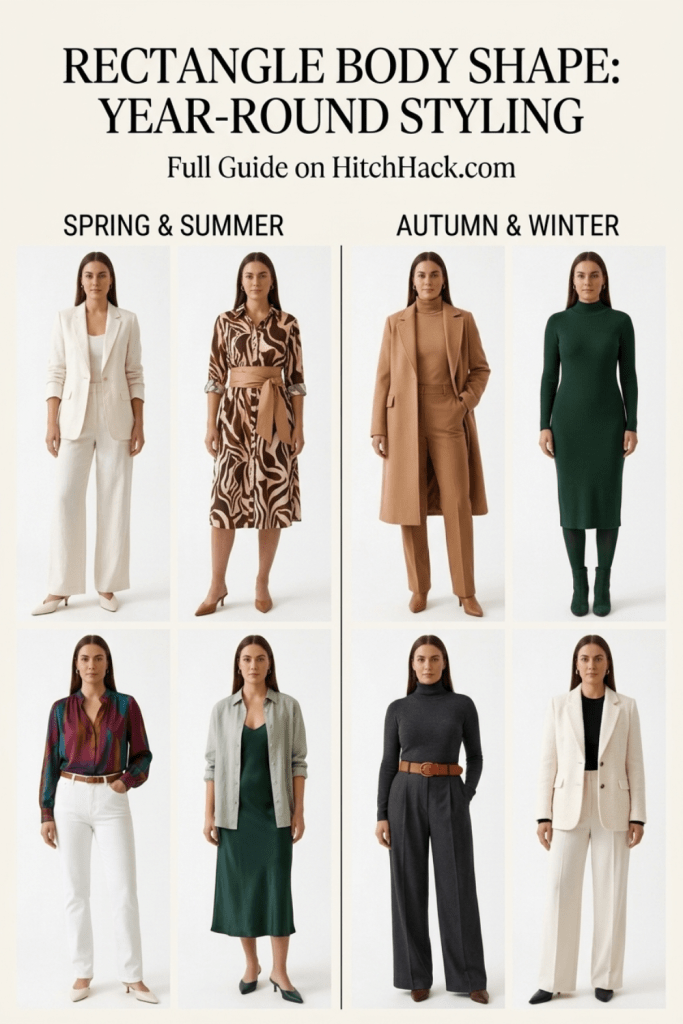
The year-round outfit formula — rectangle
Spring & Summer
- Head-to-toe ivory linen — blazer, wide-leg trouser, pointed mule in the same tone. The monochrome column at its most warm-weather precise.
- A single bold-print shirt dress in a saturated colour, belted with a wide obi in a tone pulled from the print. One decision. Complete outfit.
- White straight-leg jeans + a richly coloured or patterned blouse tucked at the front + a thin leather belt. The colour does the waist work.
- A silk slip dress in one deep tone worn under an open linen shirt two shades lighter — tonal layering that creates depth without breaking the vertical.
Autumn & Winter
- A camel coat worn over a matching camel turtleneck and slightly darker camel trouser. Three tones of the same colour. The most quietly authoritative winter look this figure owns.
- A single deep jewel tone from collar to boot — forest green knit dress, dark green tights, green suede ankle boot. Most women will not try this. That is exactly why it works.
- Charcoal wide-leg trouser + charcoal rollneck + an obi belt in cognac leather at the natural waist. One contrast element. Everything else is column.
- A boucle blazer in an off-white or warm cream over matching wide-leg trousers, with a fine black knit visible at the collar. The texture is the entire outfit.
How to dress your rectangle figure — every occasion
The two paths that govern your outer wardrobe — create the waist impression, or commit to the column entirely — apply with equal clarity in every context. At home, at the office, at a formal event, the question is always the same: are you creating a waist reference, or are you making the vertical line the point? Choose one direction. Then dress it with conviction.
At home
Lingerie and bras, Rectangle
The rectangle figure’s lingerie choices are less about structural correction and more about what the foundation layer does to the silhouette of the clothes above it. Because this figure has minimal natural waist curve, any foundation garment that adds bulk at the hip or chest without adding definition at the waist works against both of the dressing strategies available.

- The bra principle: A lightly padded or contoured underwire adds gentle bust definition, which creates a soft visual reference point above the waist. This is one of the few figures for which a bra with light padding genuinely serves the outer wardrobe — it gives a fitted top or a slip dress a focal point at the chest that contributes to the waist-impression strategy. A completely flat, unlined bralette under a shift dress, while comfortable, removes the one natural vertical anchor the silhouette has.
- Brief cut: For the rectangle figure, a high-cut brief or a Brazilian style is more useful than a full brief. A high-cut brief lengthens the leg visually and creates a slight hip curve at the outer thigh that works with the waist-impression strategy. A full brief that sits straight across the hip at its widest point reinforces the horizontal line this figure’s dressing philosophy is working to interrupt.
- Shaping, if you choose it: A light-control high-waisted brief that nips very slightly at the natural waist without compressing the hip is the most useful shaping piece for this figure — not because the body needs it, but because the gentle waist indentation it creates reads through fluid fabrics and shift dresses in a way that contributes to the silhouette’s intention. The key word remains light. Heavy compression removes the ease that makes the column silhouette work.
For a complete guide to lingerie styles, bra fitting, and the specific cuts that serve the rectangle figure at every price point: Lingerie Guide for the Rectangle Figure
Sleepwear, Rectangle
The rectangle figure in sleepwear has a genuine opportunity that most style guides ignore entirely: the column silhouette, which is one of this shape’s two strongest dressing directions, translates directly and beautifully into sleepwear. A floor-length nightgown in a fluid fabric, worn in a single tone, is simultaneously the most comfortable and the most proportionate choice this figure has for sleeping and moving around at home.

- What works: A long slip nightgown in modal, silk, or washed satin in a single rich tone — ivory, deep navy, warm sand. The column principle at its most effortless. A matching pyjama set in a quality fabric where the top is slightly cropped and the trousers are wide-leg, creating the two-tone division at the waist that the outer wardrobe relies on. A short chemise with a defined waist seam or a gathered bodice that creates a waist reference even in lightweight sleepwear fabric.
- What to avoid: An oversized sleep shirt in a shapeless cut with no waist reference worn with baggy shorts in the same tone. This is the rectangle figure’s least flattering combination in any context — the absence of both a waist reference and a tonal division leaves the silhouette reading as a single unbroken volume. It is comfortable. It does nothing else.
- Fabric first: A fluid, slightly weighted fabric — washed satin, modal, silk — is the best sleepwear fabric for this figure because it follows the body’s natural line and creates the vertical column through drape rather than through structure. Stiff cotton poplin in a shapeless cut works against both dressing strategies simultaneously.
Homewear and loungewear, Rectangle
The rectangle figure is arguably the shape that benefits most from applying the outer wardrobe’s two-direction principle to loungewear — because this figure feels the absence of intention more acutely than any other. A loungewear set with no waist reference and no tonal contrast reads as unfinished on a rectangle figure in a way it simply does not on other shapes.

- The formula at home: A wide-leg lounge trouser in a deep or neutral tone with a fitted or slightly cropped top in a contrasting colour or texture. The tonal division at the waist is the entire move — it applies the two-tone principle from the outer wardrobe to the most relaxed home context and requires no effort beyond choosing two pieces that are not the same shade. Or: a matching lounge set in one quality tone, worn as a column, with a thin belt or a tie at the waist added deliberately.
- What to avoid: A matching set in a mid-tone grey or beige where both pieces are the same weight, the same colour, and neither has any waist reference. This is the rectangle figure’s default loungewear mistake. The matching set works — but only in a rich, intentional tone, worn as a committed column, not assembled without a direction.
- The upgrade worth making: A ribbed knit lounge set where the top is a slightly cropped V-neck and the bottom is a wide-leg trouser in the same or a complementary tone. The V-neck adds a vertical line at the chest; the wide leg adds visual presence below the waist; the cropped length creates the two-tone division at the waist. Three proportion principles applied in one comfortable set, without any conscious effort on the days when conscious effort is the last thing available.
Outside the house
Office and workwear, Rectangle
The rectangle figure in professional dressing has a significant advantage that most women with this shape do not fully use. The tailored column — matching blazer and trouser in the same tone — is both the most sophisticated workwear silhouette available and the one that requires the least fit precision to execute. It was built for this body. Phoebe Philo’s decade at Céline was essentially a sustained argument for this exact principle, and the women who wore it best were almost universally rectangle figures.

- The workwear formula: A matching blazer and trouser in one considered tone — camel, deep navy, charcoal, off-white — worn over a fitted top in a contrasting colour that creates the tonal division at the waist. The blazer does not need to be belted. The contrast of the inner top against the outer column creates the waist reference through colour rather than construction.
- The belt option: A wide obi belt or a structured leather belt worn over a shirt dress or a straight blouse is the rectangle figure’s most direct workwear waist-creation tool. In a professional context, a belt in a colour that contrasts the dress — a cognac leather belt over a navy shirt dress, a black belt over an ivory shirt dress — creates an immediate and entirely polished waist reference that reads as deliberate rather than corrective.
- The dress option: A shirt dress in a quality fabric — heavy linen, silk, fine cotton poplin — worn with a structured belt at the natural waist. Or a straight-cut shift dress in one deep tone, worn with a pointed toe shoe in the same colour to extend the column to the floor. Both options apply one of the two core principles clearly and work across every professional context from boardroom to client lunch.
For a complete office dressing guide for the rectangle figure, including capsule workwear pieces and the specific column and contrast combinations worth building: Office Style Guide for the Rectangle Figure

Casual dressing, Rectangle
Casual dressing is where the rectangle figure most often abandons both of its strong directions and defaults to the neutral middle — a combination that fits perfectly, suits the occasion, and reads as though no decision was made. The solution is not more effort. It is one clear choice, made before getting dressed, about which of the two paths today’s outfit is taking.

- The casual formula: Straight-leg or wide-leg jeans in a clean, mid or deep wash, tucked with a printed, textured, or contrasting top and a thin belt at the waist. Or: a matching linen or cotton co-ord in one warm neutral — a blazer and wide-leg trouser in the same sand or ivory — worn as a deliberate column with clean white sneakers. Either direction. Either works. The neutral middle does not.
- The weekend uniform: Matching wide-leg linen trousers and a slightly cropped linen jacket in the same warm tone, worn over a fitted jersey top in a contrasting colour that shows at the waist. Clean sneakers or loafers. A structured tote. Three pieces, one principle, and a silhouette that reads as entirely intentional from across the room.
- What casual dressing is not: A plain fitted tee with straight-leg jeans in a similar mid-tone, no belt, no tuck, no tonal contrast at the waist. This combination fits this figure perfectly and communicates nothing. The fit is correct. The direction is absent. One tuck and a thin belt, or a top in a genuinely contrasting colour, is the only adjustment needed.
For a complete casual wardrobe guide for the rectangle figure, including the specific co-ord combinations and casual pieces worth investing in: Casual Style Guide for the Rectangle Figure
Events and occasion dressing, Rectangle
Occasion dressing for the rectangle figure is one of the most underrated opportunities in fashion. The column gown — which many figures cannot wear without looking either shapeless or rigid — is the rectangle figure’s native territory. A floor-length dress in a single, deeply saturated tone, cut straight from shoulder to hem in a fluid, weighted fabric, is not a compromise for this shape. It is the ideal.

- The occasion principle: Choose one direction and commit to it completely. For formal events, the column gown or a two-piece with strong tonal contrast at the waist are both excellent. The mistake is a heavily belted, ruched, gathered dress that is trying to create a waist through every available means simultaneously — it reads as effortful rather than considered, and on this figure, considered is always the more powerful choice.
- What works for formal occasions: A column gown in silk charmeuse, crepe, or velvet in a single rich tone worn to the floor. A two-piece with a structured or embellished top and a fluid wide-leg trouser or straight skirt in a contrasting tone. A shirt dress silhouette in a luxurious fabric — silk, heavy crepe — cinched with a wide belt in a complementary or contrasting colour. Each of these applies one principle cleanly and lets the fabric carry the occasion.
- The cocktail formula: A shift dress or a straight-cut midi in one deep tone, worn with a pointed-toe heel in the same shade to extend the column line. Or a contrast two-piece — a richly coloured or embellished top with a plain, dark straight skirt — where the division at the waist creates the waist impression through colour rather than construction. Both of these read as entirely formal and entirely intentional.
- Insider tip: For black tie, the rectangle figure in a column gown in ivory, deep champagne, or soft white is a more striking choice than black. The column in black is expected. The column in an unexpected tone — a warm ivory, a deep copper, a muted gold — reads as genuinely considered and uses the figure’s natural affinity for the vertical line to its fullest possible advantage. Carolyn Bessette-Kennedy understood this instinctively: the most powerful version of the column is always the one that surprises you slightly in its colour.
For a complete occasion and event dressing guide for the rectangle figure, including specific silhouettes for weddings, galas, and cocktail events: Event and Occasion Dressing Guide for the Rectangle Figure
Swimwear, Rectangle
Swimwear is where the rectangle figure’s two-direction principle produces its clearest and most immediate results. The column silhouette translates directly into a one-piece; the tonal contrast principle translates directly into a two-piece with a colour division at the waist. Both work. Both require only one decision before choosing.

- The one-piece that works: A one-piece in a single deep or rich tone with a waist cutout, a wrap detail, or a gathered section at the natural waist that creates a visual mid-point. Or a plain, clean column swimsuit in one saturated colour worn with complete conviction — this is the rectangle figure’s most elegant swimwear option and the one most style guides overlook entirely in favour of ruching and structure.
- The two-piece logic: A bikini top and bottom in two contrasting tones — a deep navy bottom with an ivory or coral top, a black bottom with a warm sand top — where the colour change sits at the natural waist and creates the tonal division that the outer wardrobe relies on. The contrast does not need to be dramatic. Even a subtle shift in tone at the waist creates a visual mid-point that reads immediately.
- What disrupts the silhouette: A matching bikini set in a single mid-tone with no waist detail and no contrast. This is the rectangle figure’s swimwear equivalent of the neutral middle — it fits correctly, suits the occasion, and communicates no direction. One contrasting piece, or one waist detail, is the only adjustment needed.
For a complete swimwear guide for the Rectangle body shape: Swimwear Guide for the Rectangle Figure
Wear this today — rectangle
- Wear: Contrasting top and bottom divided at the waist with a thin belt, or a full monochrome outfit in one deep colour
- Avoid: Drop-waist silhouettes, shapeless dresses with no waist reference, patterns that break the vertical line without intention
- Fast fix: Tuck your top in and add a thin belt. The colour division it creates does more for this figure than any other single adjustment.
- Foundation fix: If a shift dress or fitted top is reading as completely flat with no focal point, check the bra first. A lightly contoured underwire adds the gentle bust definition that gives the column silhouette a visual anchor. Try it before deciding the dress is not working.
5. The Apple / Round: Fuller Midsection, Slimmer Limbs
 The telltale moment: a wrap dress looks elegant. A trouser with a waistband that sits at the fullest point of the midsection does not. The difference is entirely about where the garment’s construction meets your body’s geometry.
Your shape references: Drew Barrymore, Queen Latifah, Melissa McCarthy — women who look polished and intentional because they work with the vertical line rather than against it. Melissa McCarthy’s best professional appearances are built almost entirely on this logic: longline layers, monochrome tonal dressing, V-necklines, and a consistent decision to show the legs rather than cover them.
The vertical line is not a trick. It is a principle, and these women apply it with the same consistency that other figures apply the waist reference or the shoulder-first rule.
The dressing philosophy: Length is your most powerful tool. A long vertical line from shoulder to hem, unbroken by contrast, makes the midsection disappear into the overall silhouette. The goal is not to minimise the waist. It is to make the full vertical height of the body the thing the eye follows. There is a significant difference between those two intentions.

Fabrics for Apple — what works and why
- Always choose: Medium-weight viscose, silk, cupro, soft ponte — fabrics that drape away from the midsection rather than clinging or standing away stiffly from it.
- Finish consideration: Always matte. Matte fabrics absorb light; shiny or metallic fabrics reflect it and amplify perceived volume.
- Avoid: Clingy jersey that interrupts the vertical drape; stiff structured fabric that stands away from the body and creates its own silhouette; wide horizontal stripes placed across the midsection.
Three moves that work in every season
- Length is everything. A top that falls to the upper thigh — rather than ending at the hip or mid-torso — creates a long vertical from shoulder to hem that the eye follows without stopping at the waist. Longline cardigans, blazers, tunic-length blouses — all operate on this principle. In winter, it translates to a longline coat worn over everything. In summer, to a longline linen blazer over a simple dress.
- Monochrome from top to hem. When top and bottom are the same colour, the eye travels the full vertical height of the body rather than stopping at the contrast. Total tonal dressing makes every figure taller and more continuous. Queen Latifah’s most powerful public appearances are almost always built on exactly this logic.
- The empire waist and the high crossing point. Any garment where the definition sits above the midsection’s fullest point — an empire-waist dress, a wrap blouse crossing above the widest measurement — places the visual waist where the body is naturally narrower. Drew Barrymore reaches for wrap and empire silhouettes consistently. The result is always intentional and elegant.

The year-round outfit formula — apple / round
Spring & Summer
- Wide-leg linen + longline linen blazer in matching tone + V-neck tee
- Wrap midi dress in matte fluid fabric — crosses above the midsection
- Dark straight-leg jeans + longline draped blazer + V-neck
- Empire-line maxi dress in one deep colour
Autumn & Winter
- Dark wide-leg trousers + longline cardigan in matching tone
- Wrap dress in matte ponte or jersey
- Slim trousers + longline coat in the same colour family
- Knit wrap top + straight trousers, total tonal
How to dress your apple figure — every occasion
The vertical line is the principle that holds in every context. At home, at the office, at a formal event — the question is always whether the outfit creates one unbroken length from shoulder to hem, or whether something interrupts it at the midsection. Interruptions at the midsection are the one thing this figure’s dressing consistently works to avoid. Everything else is a variation on that single rule.
At home
Lingerie and bras, Apple
The apple figure’s foundation layer has one non-negotiable requirement that most lingerie guides do not address with sufficient directness: nothing should sit at the midsection’s widest point and create a horizontal band of compression or visible fabric. A bra that rides up at the back, a brief with a wide waistband that digs in at the fullest point, a shapewear garment that rolls down and creates a ridge — any of these disrupts the smooth vertical line that the outer wardrobe is working to establish.

- The bra principle: A well-fitted underwire bra with a wide, flat band that stays in place is the apple figure’s most important foundation piece. A band that rides up at the back creates a horizontal line of fabric across the mid-back that is visible under anything fitted or fluid. The band should sit level, parallel to the floor, and stay there through the day. If it does not, the bra does not fit — regardless of how the cup looks. A bra that fits correctly at the band creates a smooth back line that allows fluid and draped fabrics to fall cleanly from shoulder to hem without interruption.
- Brief cut: A high-waisted brief that sits above the midsection’s fullest point — at the natural waist or just below the ribcage — is the most useful cut for this figure. It contains smoothly without compressing, and it sits above rather than across the widest measurement, which means no visible waistband ridge through fluid fabrics. A low-rise brief that sits directly at or below the midsection’s fullest point does the opposite — it creates a horizontal compression line exactly where the outer wardrobe is working hardest to avoid one.
- Shaping, if you choose it: A smooth, high-waisted brief or short in a light-control fabric worn from above the midsection to mid-thigh creates the clean vertical line that fluid draped fabrics need to fall correctly. The emphasis is on smooth, not compressed — heavy control garments create their own ridge at the hem line that is visible through anything lightweight. Light control, well-fitted, worn at the right height is worth more than heavy control worn incorrectly.
For a complete guide to bra fitting, lingerie styles, and the specific foundation pieces that serve the apple figure at every price point: Lingerie Guide for the Apple Figure
Sleepwear, Apple
The apple figure in sleepwear benefits from applying the same vertical-line principle that governs outer dressing — not because home requires the same level of intention as a professional or social context, but because the silhouettes that apply the vertical principle happen to be the most comfortable sleepwear options for this figure. Length and drape are both more comfortable and more proportionate. The interests align entirely.
- What works: A long sleep shirt or nightgown in a fluid fabric — modal, washed satin, soft viscose — that falls from the shoulder to the thigh or knee in one unbroken length. An empire-waist nightgown where any gathering or definition sits above the midsection’s fullest point. A wide-leg pyjama trouser in a soft fabric with a drawstring or elastic waist that sits at or above the natural waist, worn with a V-neck top in a matching or tonal colour.
- What to avoid: A pyjama set where the top ends at the hip’s widest point and the trouser waistband sits at the midsection’s fullest point — this creates two horizontal reference lines at exactly the two measurements this figure’s dressing avoids. A fitted sleep shirt in a clingy jersey that maps the midsection’s contour. Both are uncomfortable and both work against the vertical line simultaneously.
- Fabric first: Modal is the best sleepwear fabric for this figure without qualification. It is soft, it drapes rather than clings, it does not create static that pulls fabric inward at the midsection, and it is available at every price point. A modal nightgown or pyjama set in a deep or neutral tone is the most comfortable and most proportionate sleepwear this figure owns.
Homewear and loungewear, Apple
Loungewear is where the apple figure most frequently abandons the vertical-line principle entirely — and feels the difference most acutely. A matching tracksuit or a hoodie-and-jogger combination where the top ends at the hip and the trouser waistband sits at the midsection is the combination that feels like it should be comfortable and instead feels wrong all day without a clear reason why. The reason is that both horizontal reference lines are landing at the worst possible points simultaneously.

- The formula at home: A longline cardigan or oversized draped top in the same tone as a wide-leg lounge trouser, worn in one unbroken tonal column. Or a wrap lounge set — increasingly available in soft, fluid fabrics at every price point — where the crossing point sits above the midsection and the fabric drapes from there to the hem. Both options are genuinely comfortable, apply the vertical principle automatically, and do not require any thought on the days when no thought is available.
- What to avoid: A cropped hoodie or sweatshirt worn with a waistband trouser that sits at the midsection. This is the combination that creates the maximum number of horizontal reference lines at the maximum number of wrong points. A longline version of the same hoodie — falling to the upper thigh — in the same colour as the trouser resolves all of it without changing anything else about the outfit’s comfort level.
- The upgrade worth making: One well-made longline lounge cardigan in a deep, rich tone — a deep navy, a warm camel, a soft charcoal — that can be worn over everything at home. It becomes the apple figure’s most-used home garment because it applies the vertical-line principle to every other combination it is worn over, without requiring any additional thought or assembly.
Outside the house
Office and workwear, Apple
Professional dressing for the apple figure is where the longline-and-monochrome principle produces its most immediately powerful results. A tailored longline blazer in the same tone as the trouser beneath it is the apple figure’s single most useful workwear piece — it creates the unbroken vertical column from shoulder to mid-thigh, covers the midsection within the line of the silhouette rather than over it, and reads as entirely authoritative in every professional context.

- The workwear formula: A longline blazer falling to the upper thigh, in the same tone as a straight or wide-leg trouser below, worn over a V-neck top in a matching or slightly contrasting tone. The blazer is the vertical line. Everything else simply continues it downward. This combination works at every professional level from a creative office to a boardroom, and it requires no alteration or tailoring beyond the standard.
- The trouser rule: A pull-on trouser with an elasticated or drawstring waist that sits at or above the natural waist — rather than a structured waistband that sits at the midsection’s fullest point — is more comfortable and more flattering than any tailored trouser with a stiff waistband for this figure. In a quality fabric — ponte, heavy viscose, fine wool blend — a pull-on trouser reads as entirely professional and eliminates the fit problem that structured waistbands create consistently.
- The dress option: A wrap dress in a matte, fluid fabric — ponte, heavy jersey, matte crepe — where the crossing point sits above the midsection’s fullest point. Worn with a longline blazer or cardigan over it in the same colour family, the wrap dress and layer combination creates the vertical line through the dress while the layer extends it. This is one of the most polished and comfortable professional combinations available to this figure.
For a complete office dressing guide for the apple figure, including capsule workwear pieces and the specific longline silhouettes worth investing in: Office Style Guide for the Apple Figure

Casual dressing, Apple
Casual dressing is where this figure has the most freedom — and where the vertical-line principle, applied without effort, produces results that feel genuinely effortless rather than constructed. The combinations that work best for the apple figure casually are also the combinations that feel most relaxed to wear. Length and drape are both comfortable and proportionate. There is no tension between the two.
- The casual formula: Dark straight-leg or wide-leg jeans with a longline draped top or a tunic-length blouse in the same colour family, falling to the upper thigh. Or a wrap midi dress in a matte fluid fabric worn with flat sandals or clean sneakers. Either combination applies the vertical principle without any visible effort and works across every casual context from a weekend morning to an afternoon out.
- The weekend uniform: Dark wide-leg jeans or trousers + a longline V-neck knit in a matching deep tone + clean white sneakers or loafers. One unbroken tonal column from shoulder to shoe. The sneaker in white or a neutral adds a clean finish at the hem without breaking the vertical line. This combination requires no accessories, no layering decisions, and no styling thought — and reads as entirely considered from every angle.
- What casual dressing is not: A fitted cropped tee with high-waisted jeans where the waistband sits at the midsection’s fullest point. This combination works on every other figure and creates the specific fit problem this figure knows well — the waistband compresses at the wrong point, the top ends at the wrong place, and the outfit that looked straightforward in the shop feels uncomfortable and unresolved on the body. The longline version of the same tee — falling four inches lower — resolves all of it.
For a complete casual wardrobe guide for the apple figure, including the specific longline pieces and denim cuts worth having: Casual Style Guide for the Apple Figure
Events and occasion dressing, Apple
Occasion dressing for the apple figure is where the vertical-line principle reaches its most elegant expression. A formal context gives permission for the long column gown, the floor-length wrap dress, the dramatic wide-leg trouser in a luxurious fabric — every silhouette that creates the unbroken vertical from shoulder to hem in its most considered and refined form. The apple figure in a well-chosen formal gown is not compromising. It is working with the most flattering silhouette available to it at its highest possible execution.

- The occasion principle: Length and tone. A floor-length gown or a wide-leg trouser to the floor in a single deep, rich colour creates the longest possible vertical line this figure has available. Every additional design element — embellishment, neckline, sleeve — should sit above the midsection’s fullest point. Everything below the crossing point or the empire waist should fall cleanly and without interruption.
- What works for formal occasions: A floor-length wrap dress or gown in a matte fluid fabric — silk jersey, matte crepe, heavy viscose — where the wrap crosses above the midsection and the skirt falls from there to the floor in one unbroken line. An empire-waist gown with a defined seam above the midsection and a full or straight skirt below. A wide-leg palazzo trouser in a luxurious fabric with a draped or V-neck camisole top and a longline jacket or evening coat in the same tone over it.
- The cocktail formula: A wrap midi dress or an empire-waist dress in a single deep tone, worn to the knee or below, with a pointed-toe heel that continues the vertical line from hem to floor. Or a longline blazer in a rich evening fabric — velvet, brocade, jacquard — worn over a simple V-neck top and a wide-leg trouser in the same tone, where the blazer’s length and the trouser’s width create the vertical column at its most formal.
- Insider tip: For black tie, a floor-length wrap gown in deep jewel tones — a midnight navy, a deep emerald, a rich burgundy — is the most powerful formal option this figure has. The depth of tone creates the vertical line through colour as well as through length; the wrap crossing above the midsection places the visual waist at the narrowest available point; the floor length makes the full height of the body the dominant reading. Diane von Furstenberg’s founding insight applies here more directly than anywhere: a wrap silhouette gives every woman the confidence to walk into any room and belong there.
For a complete occasion and event dressing guide for the apple figure, including specific silhouettes for weddings, galas, and cocktail events: Event and Occasion Dressing Guide for the Apple Figure

Swimwear, Apple
Swimwear is where the apple figure’s dressing principle meets its most direct test — and where the right choice makes the most immediate and visible difference. The vertical line, the high crossing point, the absence of horizontal reference at the midsection: all three translate directly into swimwear decisions that are specific, clear, and consistently correct.
- The one-piece that works: A one-piece with a deep V or plunge neckline, a wrap front that crosses above the midsection’s fullest point, or a ruched front panel that gathers the fabric upward rather than across. A swimsuit with a built-in shelf or underwire that lifts the bust creates a high visual anchor point that draws the eye upward and establishes the vertical from the chest downward. Avoid a one-piece with a wide horizontal band or colour block at the midsection — this is the swimwear equivalent of the waistband problem, and it has the same effect.
- The two-piece logic: A tankini top that falls to the upper hip — longline enough to cover the midsection within the silhouette rather than ending at its widest point — with a plain, dark brief or short below. The tankini top is the apple figure’s most useful swimwear piece: it applies the longline principle directly, in a two-piece format, with all the practical advantages of a separate top and bottom. A bikini with a high-waisted bottom worn above the midsection’s fullest point, rather than across it, is the alternative for those who prefer a shorter top.
- What disrupts the silhouette: A bandeau or strapless top that sits across the chest without any vertical neckline element to draw the eye upward. A bikini bottom worn low on the hip with a short top that ends at the midsection — this is the swimwear version of the cropped-top-and-low-waistband combination, and it creates the same two horizontal reference lines at the same two wrong points. One piece, or a longline top with a plain bottom, resolves both problems simultaneously.
Wear this today — apple / round
- Wear: A longline layer over a V-neck in the same colour family as your trousers, creating one unbroken vertical line
- Avoid: Cropped tops, waistbands at the midsection’s widest point, shiny or metallic fabrics
- Fast fix: Add a longline blazer or cardigan in the same colour as your trousers. If you already own this combination, you have one of the most elegant looks available to this figure.
- Foundation fix: If fluid tops or wrap dresses are pulling inward at the midsection or creating an uneven drape, check the bra band first. A band that rides up at the back lifts the entire front of the garment and disrupts the vertical line from behind. A correctly fitted band that sits level and stays there is the one foundation adjustment that improves every fluid garment you own.
6. The Oval: Widest at the Midsection, Slimmer Above and Below

The telltale shopping moment: garments fit at the shoulder and at the hem but pull or add significant width across the entire central torso from underbust to hip, with no point of natural definition anywhere in between. The fitting room problem is not the bust — it is the full central torso, where no waist seam, no wrap crossing point, and no belt can find a natural narrowing to anchor to. The lower body — legs and arms — shops easily by comparison.
The dressing philosophy: The oval shape requires two governing tools applied together. First, the V-neckline — which creates a focal point above the midsection and draws the eye upward and inward, redirecting it from the midsection’s circumferential fullness toward the face and collarbone. Second, the longline vertical column — monochrome dressing, longline layers, fluid draping fabrics — which passes through and beyond the midsection without stopping at it. Neither tool alone is sufficient. Used together, they resolve the centre torso’s widest circumference into an unbroken, upward-directed silhouette.
Every outfit this figure wears begins at the neckline and extends as one unbroken vertical line to the hem. Get the neckline right and the vertical below it becomes possible. Get it wrong and nothing else fully compensates.
Adam Galinsky’s research at Columbia Business School on enclothed cognition found that wearing clothing associated with a specific identity produces measurable changes in behaviour and thinking — not merely in appearance. The woman who learns to dress with deliberate intention in the neckline — to use it as a tool rather than an afterthought — carries herself differently. The research confirms what every great stylist has always known intuitively.

Fabrics for Oval shape — what works and why
- Always: Fluid viscose, matte jersey, soft cupro — fabrics that skim rather than cling through the bust and torso, then fall freely below.
- For structure: Ponte in a matte finish — holds shape without adding perceived volume to the fullest area.
- Avoid: Anything with a defined waistband sitting at or below the natural waist, and stiff fabrics through the bust that create additional structural volume where the figure is already fullest.
Three moves that work in every season
- The V or scoop neckline as vertical architecture. A deep V or generous scoop draws a strong line from the shoulder inward and downward — the most elongating geometry available to this figure. It softens the bust line and draws the eye toward the face and collarbone rather than across the fullest horizontal point. This is not merely a styling choice. It is the primary proportion tool of this shape.
- Empire line above the bust. Any seam or gathering that sits above the bust rather than below or across it allows fabric to fall freely from the fullest point. Empire-line dresses and tops are engineered precisely for this geometry. They are available in every season and at every price point.
- Dark, continuous tone from shoulder to knee. An unbroken vertical in a deep, matte colour makes the full body read as one elegant shape. Show the legs when possible.

The year-round outfit formula — oval
Spring & Summer
- Wide-leg navy trousers + fluid V-neck blouse in same tone
- Empire-line midi dress in matte fluid fabric
- Dark straight-leg jeans + V-neck tunic to upper thigh
- Wrap dress — crossing above the midsection, deep neckline
Autumn & Winter
- Wide-leg trousers + V-neck fine knit in matching tone
- A-line midi skirt + longline V-neck cardigan
- Straight trousers + empire-line tunic in matte jersey
- Longline coat in matching tone over slim trousers
How to dress your oval figure — every occasion
Two principles hold in every context without exception. The neckline is always the focal point — open, deep, and drawing the eye upward and inward rather than across. And the vertical line from shoulder to hem is always unbroken, always in a matte fabric, always in one continuous tone. At home or at a black-tie event, the logic is identical. The fabric and the formality change. The architecture does not.
At home
Lingerie and bras, Oval
The oval figure’s bra situation is, without exaggeration, the foundation on which every other dressing decision rests. The bust is the body’s widest and most visually prominent measurement. A bra that does not fit correctly — that allows side spillage, that creates a double-bust line above the cup, that pulls the shoulder straps forward and rounds the posture — disrupts the neckline’s vertical line before any garment is even put on. Getting the bra right is not a vanity decision. It is a structural one.
- The bra principle: A full-cup underwire bra with side support panels is the oval figure’s most important wardrobe piece, bar none. The cup must contain the entire bust — no spillage at the top, no spillage at the side, no gap at the centre front. Side spillage is the specific fit failure that pushes fabric outward at the underarm and widens the bust’s horizontal reading under every top. A correctly fitted full-cup underwire eliminates this entirely. The shape it creates under a V-neck top or a fluid blouse is the foundation of the neckline’s vertical effect.
- Strap adjustment: Straps that are too long allow the bust to drop forward, which rounds the shoulder and shortens the neck — the two things the V-neckline strategy is working to lengthen and open. Adjust straps so the bust sits at the mid-chest level, not low on the torso. This single adjustment changes the reading of every V-neck and scoop top worn over it.
- Brief cut: The oval figure’s lower body shops easily, which means the brief choice is genuinely free. A high-cut brief or a Brazilian style adds a small amount of visual presence at the hip, which works with the figure’s slight taper below the bust. A full brief in a smooth, seamless fabric is equally useful under fluid trousers. The one cut to avoid is a brief with lace or textured trim at the hip that creates a visible ridge under fluid fabrics — the oval figure’s wardrobe relies on smooth, uninterrupted drape from bust to hem.
For a complete guide to full-bust bra fitting, lingerie styles for the oval figure, and specific recommendations at every price point: Lingerie Guide for the Oval Figure
Sleepwear, Oval
The oval figure in sleepwear has one requirement above all others: support at the bust, even at rest. A sleep bra or a camisole with a built-in shelf that provides light support through the night is worth having not only for comfort but because unsupported movement through the night strains the bust’s surrounding tissue in a way that affects posture over time. This is not a comfort detail. It is a long-term structural investment.
- What works: A camisole with a built-in shelf bra or a soft, wire-free bralette worn under a loose sleep shirt or nightgown. A V-neck or scoop-neck nightgown in a fluid fabric — modal, washed satin, soft viscose — that falls from the shoulder without sitting on or clinging to the bust. An empire-waist nightgown where the seam sits above the bust and the fabric falls freely from there to the hem — this is the sleepwear equivalent of the empire-line dress and applies the same proportion principle with the same result.
- What to avoid: A fitted sleep shirt in a clingy jersey that maps the bust’s contour and creates the horizontal emphasis the waking wardrobe is consistently working to avoid. A spaghetti-strap camisole with no support — comfortable in theory, disruptive to bust position in practice. A pyjama top with a crew neck or a high, closed neckline that removes the vertical neckline element entirely, leaving the bust as the outfit’s only focal point.
- Fabric first: Modal and washed satin are the best sleepwear fabrics for this figure. Both drape rather than cling, both fall from the shoulder through the bust to the hem without mapping the body’s contour, and both are available in V-neck and scoop-neck nightgown silhouettes at every price point. A modal V-neck nightgown in a deep tone is the oval figure’s most comfortable and most proportionate sleepwear choice.
Homewear and loungewear, Oval
Loungewear presents the oval figure with the same challenge it presents at every dressing level: most lounge sets are designed with a crew or round neckline, a fitted top, and a waistband that sits at the midsection. Every one of these design choices works against the two principles this figure’s dressing relies on. The solution is not complicated, but it requires one deliberate decision at the point of purchase.
- The formula at home: A wide-leg lounge trouser in a fluid fabric with a drawstring or elasticated waist sitting above the midsection, worn with a V-neck or wrap lounge top in the same or a deeply tonal matching colour. The V-neck does its vertical work even in a lounge context. The wide leg creates the lower-body presence that balances the bust above. Together they apply both core principles without any visible effort.
- What to avoid: A matching lounge set where the top has a crew neck, a fitted silhouette through the bust, and a hem that ends at the hip. This combination closes the neckline, maps the bust’s widest point, and ends the top at the midsection’s fullest measurement simultaneously. All three design choices are wrong for this figure. A V-neck version of the same set, in the same fabric, costs no more and applies the proportion principle automatically.
- The upgrade worth making: A wrap lounge set in a quality fluid fabric — brushed modal, washed linen, soft ribbed knit — where the top crosses above the midsection and creates a deep V at the chest. The wrap lounge top is the oval figure’s most useful at-home garment: it applies the neckline principle, the empire-crossing principle, and the fluid-drape principle in one piece. Worn consistently at home, it makes the outer wardrobe’s dressing decisions feel easier because the principle becomes instinctive rather than considered.

Outside the house
Office and workwear, Oval
Professional dressing for the oval figure requires one decision made clearly before anything else: the neckline. Every other workwear choice — trouser cut, fabric weight, layering strategy — is secondary to whether the neckline is open and vertical or closed and horizontal. A closed neckline in a professional context on this figure removes the one architectural element that makes everything else work, and no amount of correct trouser cut or good fabric will fully compensate for it.
- The workwear formula: A V-neck blouse or a wrap top in a fluid, matte fabric, tucked at the front only into a wide-leg or straight tailored trouser in the same deep tone, with a longline blazer or unstructured jacket worn open over it. The blazer worn open preserves the V-neckline’s vertical line rather than closing it. The trouser and blazer in the same tone create the unbroken vertical below. The wrap or V-neck does the architectural work at the top. Three pieces, two principles, one direction.
- The trouser rule: A pull-on wide-leg trouser with a waistband that sits above the midsection — or a trouser with a flat front and a low-rise cut that does not press against the midsection’s fullest point — is more comfortable and more flattering than a structured waistband trouser for this figure. In a quality ponte or heavyweight viscose, a pull-on trouser reads as entirely professional and eliminates the specific fit discomfort that structured waistbands create at the midsection.
- The dress option: An empire-waist dress in a matte, fluid fabric with a V or scoop neckline, worn with a longline open blazer in the same colour family. The empire seam sits above the bust’s widest point; the fabric falls freely from there to the knee; the blazer extends the vertical line and adds the professional layer without closing the neckline. This is the oval figure’s most polished and most comfortable professional combination, and it works at every level of formality from a casual office to a client-facing role.
For a complete office dressing guide for the oval figure, including capsule workwear pieces and the specific neckline and silhouette combinations worth building: Office Style Guide for the Oval Figure
Casual dressing, Oval
Casual dressing for the oval figure is where the neckline principle is easiest to apply and most frequently abandoned. A weekend morning produces the crew-neck sweatshirt, the round-neck tee, the high-neck knit — all comfortable, all closing the one architectural element that makes this figure’s dressing work. The solution requires no additional effort. It requires only a different neckline on the same garment.

- The casual formula: Dark straight-leg or wide-leg jeans with a V-neck or scoop-neck tunic top falling to the upper thigh, in the same deep or neutral tone as the jeans. Or a wrap midi dress in a matte fluid fabric with flat sandals or clean sneakers. Either combination applies both principles — the open neckline and the continuous vertical — in a completely relaxed context and requires nothing beyond the two pieces themselves.
- The weekend uniform: Dark wide-leg jeans + a deep V-neck fluid top in the same dark tone, falling to the upper thigh + a longline open cardigan in a matching colour + clean loafers or flat sandals. Four pieces, one unbroken vertical from neckline to shoe, the V doing its architectural work at the top. This combination is genuinely comfortable, requires no accessories to read as considered, and translates from a morning errand to an afternoon lunch without any adjustment.
- What casual dressing is not: A crew-neck jersey dress with a defined waist seam at the midsection. This combination closes the neckline, creates a horizontal reference at the bust’s fullest point, and places a second horizontal at the midsection simultaneously. The V-neck version of the same dress, in the same fabric, resolves every one of those issues without changing anything else about the outfit’s comfort or ease.
For a complete casual wardrobe guide for the Oval figure, including the specific layering combinations and casual pieces worth having: Casual Style Guide for the Oval Figure
Events and occasion dressing, Oval
Occasion dressing for the oval figure, approached with the neckline as the primary tool and the vertical line as the governing principle, produces some of the most genuinely striking formal silhouettes available. A deep V-neck gown in a fluid, matte fabric falling to the floor in one unbroken deep tone is not a compromise for this figure. It is the most powerful formal option it has — and one that most other figures cannot carry with the same authority.

- The occasion principle: The neckline carries the drama. Everything else — skirt line, sleeve, length — is in service to the vertical. A deeply V-cut neckline draws every eye in the room from the shoulder to the collarbone to the face. That is the intended direction of attention. The gown below it should be as quiet and as continuous as possible — one tone, fluid fabric, falling cleanly to the floor without interruption.
- What works for formal occasions: A floor-length V-neck or surplice-neck gown in a matte fluid fabric — silk jersey, matte crepe, heavy viscose — in one deep jewel tone. An empire-waist gown with a V or scoop neckline where the seam sits above the bust and the skirt falls from there to the floor in a clean A-line or column. A wide-leg palazzo trouser in a luxurious fabric with a deeply V-cut camisole or draped halter top and a longline evening jacket worn open in the same tone over it.
- The cocktail formula: A wrap dress in a rich evening fabric — silk charmeuse, velvet, heavy crepe — where the wrap creates a deep V neckline and crosses above the midsection, worn to the midi or knee. Or an empire-waist dress in a single deep tone with a V or scoop neckline and a skirt that falls to the knee or below. Both apply the two principles at their most formal and most refined.
- Insider tip: For black tie, deep jewel tones carry more authority on this figure than black. Black is correct. A deep emerald, a midnight sapphire, a rich plum, or a warm burgundy in a floor-length V-neck gown reads as more deliberately chosen and more visually striking than the standard black option — because the depth of colour reinforces the vertical line through tone as well as through length. Yves Saint Laurent’s understanding that a woman can claim any silhouette she chooses and make it entirely her own applies here with full force: the oval figure in a floor-length jewel-tone V-neck gown is not dressing around her shape. She is dressing with it.
For a complete occasion and event dressing guide for the oval figure, including specific silhouettes for weddings, galas, and cocktail events: Event and Occasion Dressing Guide for the Oval Figure
Swimwear, Oval
Swimwear is where the oval figure’s neckline principle meets its most direct and most visible application. The bust is the dominant measurement; the neckline is the primary architectural tool; the vertical line from neckline to hem is the governing principle. In swimwear, all three translate into decisions that are specific, immediately visible, and consistently correct when applied.

- The one-piece that works: A one-piece with a deep V or plunge neckline, underwire or built-in boning that fully supports the bust without compressing it, and a plain, dark or deeply tonal lower half with no horizontal design detail at the midsection. The neckline does its vertical work; the underwire contains the bust cleanly within the cup; the plain lower half allows the eye to follow the vertical from neckline to hem without interruption. This is the oval figure’s strongest swimwear option and the one that requires the least additional thought to assemble correctly.
- The two-piece logic: A tankini top with a V or surplice neckline, built-in underwire support, and a hem that falls to the upper hip — long enough to skim the midsection within the silhouette rather than ending at its widest point — with a plain, dark brief or short below. The tankini applies the longline principle in a two-piece format and gives the practical flexibility of separates while maintaining the neckline and vertical-line principles. A bikini works for this figure only with a V-neck or surplice top that has genuine underwire support — a standard triangle bikini top with no support on a fuller bust creates exactly the horizontal spread at the chest that the dressing strategy is consistently working to avoid.
- What disrupts the silhouette: A bandeau or strapless one-piece or bikini top. Without a vertical neckline element, the bust becomes the sole and widest visual anchor point with nothing drawing the eye upward or inward from it. A swimsuit with a strong horizontal colour block at the bust or midsection. A high-neck swimsuit that closes the neckline entirely — this removes the only architectural element that creates the vertical line in a swimwear context, and no amount of colour or pattern will compensate for its absence.
For a complete swimwear guide for the Oval body shape: Swimwear Guide for the Oval Figure
Wear this today — oval
- Wear: A strong V-neck or scoop top with a fluid, untucked hem over the widest point, in the same colour as your trousers
- Avoid: Crew necks, boat necks, anything that crosses the bust as a strong horizontal line
- Fast fix: Open the top two buttons of whatever you are wearing. The V it creates is immediate and costs nothing.
- Foundation fix: If a V-neck top or fluid blouse is pulling outward at the underarm or creating an uneven line across the chest, the issue is side spillage from the bra cup. The garment is not the problem. A correctly fitted full-cup underwire that contains the bust entirely within the cup resolves this in every top you own, without exception.
7. The Athletic Build:Every Shape, Drawn in Muscle
The telltale moment: a dress fits perfectly everywhere and still reads as neutral, or a fitted tee looks faintly like gym kit no matter what you pair it with. That is not a fit problem. It is a defined surface asking for texture. If you have always called yourself “athletic” and reached for straight-figure advice, you were half right. Your proportion shape is almost certainly Rectangle, and the athletic build is the layer that sits on top of it. Read the Rectangle section for your silhouette logic, then the athletic build for the texture-and-layering layer that makes it read as fashion rather than fitness.
Your references: Cameron Diaz and Gisele Bündchen (athletic rectangle), Halle Berry (athletic hourglass), Serena Williams and Michelle Obama (athletic inverted triangle), Misty Copeland (athletic pear). None of them dressed “the athletic body.” Each dressed her own proportion, in muscle, with conviction.
The dressing philosophy: texture, layering, and deliberate contrast do the visual work that soft curvature provides on other bodies. You are not dressing to fake a curve. You are choosing which of the frame’s own defined lines to feature, and which to quiet, and letting a rich fabric carry the surface.

Athletic Body? Here’s How to Create Curves Instantly (No Gym Needed). Create curves visually with peplum & wrap tops, waist emphasis and textured fabrics. NOTE: The numbers illustrate the pattern, not the expectation.
Fabrics for Athletic — what works and why
- Best: Textured weaves, structured linen, boucle, jacquard, thick knit — fabrics with their own visual weight that do not rely on the body beneath them to create interest.
- For layering: Lightweight crepe, fine jersey — as base layers beneath structured or textured outer pieces.
- Avoid alone: Plain, featureless fabrics in simple silhouettes with no layering or texture — they have nothing to add to this figure’s canvas and will read as completely flat.
Three moves that work in every season
- Layering as proportion play. An open shirt over a fitted tee, a longline coat over a simple dress, a structured jacket over a fluid blouse — layering creates the visual depth and proportion contrast that this figure’s natural measurements do not provide. Karlie Kloss has built her off-duty wardrobe almost entirely on this principle. The technique translates from summer (a light open shirt over a slip) to winter (a structured coat over a knit dress) without changing its logic.
- Statement sleeves and shoulders. Because the shoulder line is already clean and balanced, this figure carries sleeve volume better than almost any other. A puffed sleeve, a wide bishop sleeve, a sculptural shoulder — these read as intentional fashion choices on the athletic figure rather than as overcompensation. The body provides the structure. The sleeve provides the statement.
- The contrast texture outfit. A heavily textured top paired with a fluid bottom, or vice versa. The contrast between fabric weights creates visual interest at the border between top and bottom — which functions as a proportion division without requiring a belt or a defined waistline. Halle Berry reaches for this contrast instinctively.
The year-round outfit formula — athletic / straight
Spring & Summer
- A broderie anglaise or heavily textured white blouse with wide-leg linen in a warm tan. The blouse carries all the visual interest. The trouser is simply there to support it.
- A midi slip dress in washed satin worn under a structured overshirt in a contrasting weave, left entirely open. Two fabric weights. One silhouette.
- A bold, large-scale printed top — the kind most figures avoid — with a fluid plain wide-leg trouser. This figure is the one that print was designed for.
- Straight-leg jeans in a clean mid-wash + a vintage-style camp collar shirt in a saturated colour or retro print, worn open over a fitted white tee. Three layers. Reads as effortless.
Autumn & Winter
- A sculptural chunky knit — one with genuine architectural weight, not a thin jersey pretending to be a knit — over straight-leg trousers in a deep tone. The knit is the entire statement.
- A leather or faux leather wide-leg trouser in warm tan or deep chocolate, worn with a fine ribbed turtleneck in cream. The contrast between the trouser’s weight and the knit’s fineness is the outfit’s intelligence.
- A heavy wool midi skirt in a bold check or plaid with a plain fitted base layer and a longline structured coat over it. Layers in genuinely different weights, chosen with intention.
- A velvet blazer in a rich jewel tone — worn as the only statement, over slim dark trousers and a simple V-neck. One piece of genuine fabric luxury. Nothing competing with it.
How to dress your athletic figure — every occasion
The principle that holds in every context is the same one that governs the outer wardrobe: texture, layering, and deliberate contrast do the work that body curvature does not provide. At home, at the office, at a formal event — the question is always whether the outfit has enough visual interest and enough intentional contrast to make the straight-lined silhouette feel like a statement rather than a neutral. The answer is always found in fabric weight and layering depth, not in fit.

At home
Lingerie and bras, Athletic
The athletic figure’s lingerie choices are less structurally constrained than any other shape — there is no significant cup-to-band disparity, no dramatic hip-to-waist difference, no fit tension between body measurements. The bra and brief situation is, by any measure, the most straightforward of all the body shapes. The choices worth making are about what the foundation layer adds to the outer wardrobe’s texture and contrast strategy, rather than what it corrects.
- The bra principle: A lightly contoured or lightly padded underwire adds a soft bust definition that gives textured tops and layered outfits a more interesting focal point at the chest. This is the one figure for which a bra with gentle padding genuinely serves the outer wardrobe’s statement-making goal — it creates a slightly more pronounced bust line that gives structured and textured fabrics something to fall from and frame. A completely unlined bralette under a heavily textured top removes the one natural focal point the layering strategy is working to create above the waist.
- Brief cut: The athletic figure has genuine freedom here. A high-cut brief adds a small amount of visual hip curve that works with any waist-creation strategy. A Brazilian or cheeky cut sits cleanly and reads well under both fluid and structured bottoms. The one consideration worth making: under the contrast-texture combinations this figure relies on, a seamless brief in a smooth microfiber eliminates any visible line through fluid fabrics that might interrupt the outfit’s clean base layer.
- Bralette as visible layer: The athletic figure carries the bralette-as-visible-accessory better than almost any other shape. A lace or textured bralette worn deliberately visible under an open shirt, a sheer blouse, or a structured blazer adds a layer of visual texture at the chest that contributes directly to the outer wardrobe’s contrast and layering strategy. It is both a foundation garment and a styling element simultaneously — the athletic figure’s most versatile lingerie piece.
For a complete guide to lingerie styles, bra fitting, and the specific foundation and styling pieces that serve the athletic figure at every price point: Lingerie Guide for the Athletic Figure
Sleepwear, Athletic
The athletic figure in sleepwear has more freedom than any other shape and the most to gain from using that freedom with some intention. Because fit is not a constraint and proportion correction is not a requirement, sleepwear becomes a genuine opportunity to apply the texture and contrast principle in its most relaxed form — or to abandon it entirely and wear whatever is most comfortable, with no real consequence either way.
- What works: A pyjama set where the top and bottom are in contrasting tones or textures — a printed or textured top with a plain bottom, or two different but complementary fabrics. A slip nightgown in a fabric with some inherent visual interest — a washed satin, a ribbed modal, a lace-trimmed silk — that applies the texture principle in a single piece. A short wrap robe in a richly textured or printed fabric worn over a simple base, which layers even at home and applies the contrast principle without any effort.
- What to avoid: A plain matching set in a featureless jersey with no print, no texture, and no contrast between top and bottom — this is the sleepwear equivalent of the technically correct outfit that feels completely neutral, and it produces the same mild dissatisfaction. It is not wrong. It is simply doing nothing. One piece with some visual interest, even at home, costs nothing extra and makes a visible difference.
- Fabric first: The athletic figure is the one shape for which any fabric works well in sleepwear. The question is not which fabric suits the body — it is which fabric has enough inherent interest to apply the texture principle even at rest. A washed satin, a ribbed knit, a printed cotton, a lace-trimmed modal — any of these adds the visual weight that a plain featureless fabric does not.
Homewear and loungewear, Athletic
Loungewear is where the athletic figure has the greatest freedom and uses it least deliberately. The temptation is a plain matching set in a single tone — which fits perfectly, suits the context, and communicates nothing. The athletic figure does not need to dress for structure or proportion correction at home. It needs one piece with visual weight or textural interest to prevent the outfit from reading as completely neutral, which is the single consistent frustration of dressing this body in any context.
- The formula at home: A wide-leg lounge trouser in a plain, fluid fabric worn with a textured, ribbed, or printed top in a contrasting tone. Or a matching lounge set where both pieces are in a fabric with inherent visual interest — a ribbed knit, a waffle weave, a brushed textured modal — rather than a plain featureless jersey. The texture does the work. The fit takes care of itself, because on this figure it always does.
- The visible bralette opportunity: The athletic figure is the one shape that can wear a textured or lace bralette visible under a loose open lounge shirt or a relaxed kimono wrap at home with genuine style rather than accidental exposure. This is the texture-as-layering principle applied to its most relaxed context — and on this figure, it reads as entirely intentional and entirely considered, even when the rest of the outfit requires no thought at all.
- The upgrade worth making: One well-made lounge set in a fabric with real visual weight — a chunky ribbed knit, a thick waffle cotton, a brushed textured modal — in a rich, deep tone. The fabric’s inherent interest does everything a plain jersey set does not. Worn consistently at home, it applies the texture principle automatically and eliminates the specific mild dissatisfaction that plain, featureless loungewear produces on this figure every single time.
Outside the house
Office and workwear, Athletic
Professional dressing is where the athletic figure’s advantage becomes most apparent and most underused. The garment hangs cleanly. The shoulder line is balanced. The fit requires no alteration. The only question — the same question in every dressing context — is whether the outfit has enough visual interest and enough deliberate contrast to read as considered rather than merely correct. In a professional setting, that question is answered through fabric texture, layering depth, and the specific combination of structure and softness.
- The workwear formula: A structured blazer in a textured fabric — a fine boucle, a subtle jacquard, a heavyweight linen — worn over a fluid or fine-knit base layer in a contrasting tone, with straight or wide-leg tailored trousers. The blazer provides the texture and structure; the base layer provides the contrast; the trouser continues the line below. Three pieces, one principle: the contrast between the blazer’s texture and the base layer’s smoothness creates the visual interest that this figure’s straight-lined silhouette does not generate alone.
- The statement sleeve option: A professional blouse with a structured or slightly voluminous sleeve — a subtle bishop sleeve, a cuffed wide sleeve, a gathered cap sleeve — worn with simple, clean tailored trousers and no additional layering. On the athletic figure, a statement sleeve in a professional context reads as a deliberate fashion choice rather than an attempt at proportion correction, because the shoulder is clean and balanced. It is one of the few figures that can wear architectural sleeve detail in a boardroom without it reading as costume.
- The dress option: A textured shift dress — boucle, jacquard, thick wool blend — worn with a contrasting fine-knit layer beneath or a structured blazer over. The dress provides the statement fabric; the layer creates the depth. A plain shift dress with no layering and no textural interest is the one professional option this figure should consistently avoid — it is technically correct and entirely unmemorable in equal measure.
For a complete office dressing guide for the athletic figure, including capsule workwear pieces and the specific texture and layering combinations worth building: Office Style Guide for the Athletic Figure

Casual dressing, Athletic
Casual dressing is where the athletic figure is most tempted by the plain, featureless combination — and where the texture-and-layering principle is easiest and most enjoyable to apply. A weekend context allows for the full range of contrast combinations: heavy knit over fluid slip, structured overshirt over fitted base, printed statement piece against a plain neutral. The casual wardrobe is where this figure can experiment most freely with the principle, because the stakes of getting it wrong are lowest and the visual reward of getting it right is immediate.
- The casual formula: Straight or wide-leg jeans in a clean wash with a textured or structured top — a boucle knit, a printed blouse, a heavily woven linen shirt — and one open layer over it in a contrasting fabric weight. Or a midi slip dress in a fluid fabric with a chunky knit or structured overshirt layered over it. Both combinations apply the contrast-texture principle in their most relaxed form and require nothing beyond the pieces themselves to read as entirely intentional.
- The weekend uniform: Straight-leg jeans in a dark or mid wash + a heavily textured knit or printed blouse + an open overshirt or light jacket in a contrasting fabric, half-tucked at the front + clean white sneakers or loafers. Four pieces, one principle, a visible layering depth that reads as considered from across the room. The specific textures and tones can rotate with season and mood. The structure of the combination stays constant.
- What casual dressing is not: A plain fitted tee with straight jeans and no layering, no texture, and no statement element. This is the athletic figure’s most common casual default and its least interesting result. The fit is perfect. The outfit communicates nothing. One textured layer — a chunky cardigan, a printed overshirt, a boucle jacket — added over the same combination transforms it from technically correct to genuinely considered, with no additional effort beyond the extra piece.
For a complete casual wardrobe guide for the athletic figure, including the specific layering combinations and casual pieces worth having: Casual Style Guide for the Athletic Figure

Events and occasion dressing, Athletic
Occasion dressing for the athletic figure is where the statement principle reaches its highest and most exciting expression. A formal context gives full permission for the most architecturally interesting garments in fashion — the sculptural sleeve, the heavily embellished bodice, the dramatically textured gown, the bold contrast two-piece. Every one of these is at its most powerful on a figure that provides a clean, balanced foundation and does not require the garment to do any proportion work. The athletic figure wears the statement. The statement does not wear the figure.
- The occasion principle: One strong statement element, executed at the highest possible level the occasion allows. A gown with a dramatically sculptural sleeve or shoulder in a matte, heavily textured fabric. An embellished bodice on a clean, fluid skirt. A bold contrast two-piece where the fabric, colour, or texture of one piece is the entire point of the outfit. The athletic figure does not need a defined waist or a proportion-balancing silhouette. It needs one piece of the outfit to be genuinely interesting, and it wears that interest better than almost any other shape.
- What works for formal occasions: A column gown in a heavily textured fabric — embellished, beaded, heavily woven, or sculptural — worn in a single deep tone. A two-piece with a dramatically structured or embellished top and a clean, fluid wide-leg trouser or straight skirt below. A gown with statement sleeves — a bishop sleeve, a dramatic puff, an architectural off-shoulder — in a matte, weighted fabric that holds the sleeve’s shape independently of the body beneath it. Any of these applies the statement principle at its most formal level and uses the athletic figure’s clean proportions as the ideal foundation for the garment’s architectural ambition.
- The cocktail formula: A mini or midi dress in a heavily textured or embellished fabric — brocade, velvet, jacquard, beaded — with a clean silhouette and a strong sleeve or neckline detail. Or a contrast two-piece where one piece is the statement and the other is deliberately quiet — a plain fluid skirt with a heavily embellished top, or a textured structured jacket with a simple slip dress beneath. The contrast between the statement piece and the quiet piece is the outfit’s architecture.
- Insider tip: For black tie, the athletic figure in a heavily embellished or architecturally structured gown is the most powerful formal option available — and the one that most women with this shape do not reach for, because they default to the fluid column that technically fits perfectly and produces the same mild neutrality in a floor-length format. A gown with genuine architectural interest — a sculptural sleeve, a dramatically textured bodice, a bold structural silhouette — on the athletic figure’s clean proportions is the combination that fashion was originally designed to produce. Rei Kawakubo of Comme des Garçons spent a career arguing that the garment is the statement and the body is the canvas. The athletic figure is the canvas she had in mind.
For a complete occasion and event dressing guide for the athletic figure, including specific silhouettes for weddings, galas, and cocktail events: Event and Occasion Dressing Guide for the Athletic Figure
Swimwear
Swimwear is where the athletic figure’s freedom from proportion constraints is most directly and most enjoyably expressed. There is no silhouette that does not fit. There is no cut that creates a proportion problem. The swimwear question for this figure is identical to the outer wardrobe question: does the choice have enough visual interest, enough texture, enough deliberate contrast to feel like a statement rather than a neutral? The answer is found in pattern, fabric texture, and the specific boldness of the piece chosen.

- The one-piece that works: A one-piece in a bold print, a richly textured fabric, or a dramatically cut silhouette — a deep plunge, an architectural cutout, a sculptural neckline — that would overwhelm a figure with more pronounced proportions. The athletic figure carries these without the garment reading as too much, because the clean proportions beneath provide balance rather than competition. A plain, featureless one-piece in a single neutral tone is the swimwear equivalent of the plain fitted tee: technically fine, genuinely unmemorable.
- The two-piece logic: A bikini with a statement top — a textured fabric, a bold print, a structured underwire with an interesting neckline detail, a dramatic tie or frill — and a plain, clean bottom in a complementary tone. Or a contrasting two-piece where top and bottom are in two deliberately different tones or patterns that create the same visual interest at the waist division that the outer wardrobe’s contrast combinations create at the belt line. The athletic figure is the one shape that can wear a mismatched bikini set as a considered style choice rather than an accident.
- Statement swimwear is not excess: A ruffle, a bold print, a textured fabric, a sculptural one-shoulder, an architectural cutout — on the athletic figure, none of these reads as too much. They read as exactly right. This is the figure that fashion editors reach for when they want to photograph a statement swimsuit, because the clean proportions carry the garment’s ambition without any visual competition from the body beneath it. Use that freedom. It is the athletic figure’s most significant swimwear advantage and the one most consistently left unused.
For a complete swimwear guide for the athletic figure, including specific statement silhouettes and the brands that design swimwear with this figure’s freedom in mind: Swimwear Guide for the Athletic Figure
Wear this today — athletic / straight
- Wear: At least one textured or structured piece and one layer — even a light open shirt over a fitted base
- Avoid: Monochrome outfits in plain, featureless fabrics with no layering, texture, or statement element
- Fast fix: Add a textured outer layer — even a chunky knit cardigan over whatever you are wearing. The contrast between textures does more for this figure than any other addition.
- Foundation fix: If a textured or layered outfit is reading as flat despite the pieces being correct, check the base layer first. A completely plain, unlined bralette under a structured outer layer removes the one focal point at the chest that gives the layering its anchor. A lightly contoured underwire or a visible textured bralette worn deliberately as part of the layer resolves it immediately.
8. The Petite Figure: Every Shape, Scaled With Intelligence
The telltale moment: a midi that reads as ankle-grazing on a taller figure hits you at the widest part of the calf, which is an entirely different silhouette with entirely different consequences. A standard blazer swims at the shoulder and drops past the hip.
Your references: Eva Longoria (5’2″), who chooses the shoe before the dress because the heel sets the hem and the hem sets everything; Salma Hayek (5’2″), who references a waist in one unbroken tone; Sabrina Carpenter (5’0″–5’1″), whose pointed toe is a proportion signature; Reese Witherspoon (5’1″), who dresses from understanding rather than hope.
The dressing philosophy: one clean, uninterrupted length from shoulder to hem, scaled precisely to the frame carrying it. The completed guide maps all six petite shapes, adds the Break-Point Map, the shoe-first Hem System, the 40+ guide, and every occasion.

Fabrics for Petite — what works and why
- Best: Fluid but not flimsy fabrics in light to medium weights — matte silk, cupro, fine viscose, soft crepe, refined ponte, lightweight wool, and softened linen. These skim the frame cleanly, create a longer vertical line, and avoid overwhelming a petite silhouette with unnecessary bulk.
- Especially useful: Fabrics with gentle structure and a smooth finish — cotton poplin, fine twill, compact knit, and lightweight denim with slight stretch. They hold shape where needed, keep proportions precise, and help garments look intentional rather than oversized.
- Avoid: Very bulky knits, thick padded fabrics, heavy stiff denim, dense textured weaves, and anything with excessive volume. On a petite frame, these shorten the silhouette, widen the appearance, and make outfits feel heavier and less refined.
The scale rules that change everything
- Length is everything — and always assess with your actual shoes. A midi skirt that hits at the right point in the dressing room will hit differently with flat shoes versus a two-inch heel. Always try garments with the footwear you plan to wear them with. Hem placement is the most common and the most correctable fit problem for petite figures, and it is correctable.
- Vertical lines elongate; horizontal lines divide. A petite figure has limited vertical height to allocate. Every horizontal line — a contrasting waistband, a strong colour break at mid-torso, a belt in a different colour from the rest — subdivides that height. Vertical lines — a longline cardigan, a continuous-colour outfit, a V-neck — add length. This is not a prohibition. It is a proportion consideration for every decision involving horizontal design elements.
- Monochrome is the most powerful single tool. An outfit in one continuous colour from shoulder to hem — or in closely related tones — gives the eye an uninterrupted vertical to follow. This creates the impression of height more reliably than heels alone, more reliably than any specific silhouette.
- Scale prints to the frame. A large-scale print that looks editorial at five-foot-eight reads as overwhelming at five-foot-two. This is purely about the proportion between the pattern repeat and the visible area of the garment. Small to medium-scale prints — or prints with a clearly vertical, directional movement — are the reliable answer.

The year-round outfit formula — petite
Spring & Summer
- Wide-leg trouser hemmed exactly to your height + fitted top in same colour
- Wrap midi dress hemmed to just above or at the knee
- Monochrome linen outfit in one warm neutral
- Slim or straight jeans + fitted top + pointed-toe shoe
Autumn & Winter
- Slim trousers + longline coat in the same colour — the monochrome column
- Knit dress in one deep colour + ankle boot in matching tone
- Straight-leg trousers + fitted turtleneck in same shade
- Petite-cut blazer (shorter body, refined shoulder) + matching trousers
How to dress your petite figure — every occasion
Every occasion section below applies the petite scale rules on top of your specific body shape’s principles. The shape logic does not change. What changes is the scale at which every decision is made — hem length, fabric weight, print size, layering depth — and the consistent priority given to the vertical line over any horizontal division. In every context, the goal is the same: one clean, uninterrupted length from shoulder to hem, scaled precisely to the frame carrying it.
At home
Lingerie and bras, Petite
The petite figure’s lingerie choices carry more visible consequence than those of taller figures, for a reason that most guides do not state directly: on a shorter frame, a bra that does not fit correctly changes the torso’s visible proportions significantly. A band that rides up shortens the back’s visible length. A cup that gaps adds fabric bulk at the chest. A strap that is too long drops the bust toward the mid-torso, visually shortening the distance between bust and waist — the measurement that petite dressing works hardest to maximise.

- The bra principle: A well-fitted underwire with straps adjusted to hold the bust at the mid-chest — not low on the torso — is the petite figure’s most important foundation investment. Bust height matters to this figure more than to any other: a bust carried at the correct mid-chest height creates the maximum visible distance between bust and waist, which is the proportional space that makes the torso read as longer. A bust that has dropped toward the mid-torso compresses that space and shortens the visible torso regardless of what is worn over it.
- Bra bulk and the petite frame: A heavily padded or multi-layer bra cup adds physical volume at the chest that, on a petite frame, reads as bulk rather than shape. A smooth, lightly lined underwire gives the correct amount of definition without adding the visual weight that shortens the torso’s apparent length. The principle is the same as it is in outer dressing: scale the foundation to the frame.
- Brief cut: A high-cut brief is the petite figure’s most useful option regardless of body shape — it lengthens the leg line visually from the hip downward, which contributes to the same elongation effect that the outer wardrobe’s monochrome strategy achieves from the outside. A full brief sitting at mid-hip creates a horizontal line at the leg’s widest point that shortens the leg’s apparent length under fluid skirts and dresses. The difference is visible. The adjustment costs nothing.
For a complete guide to bra fitting for petite frames, the specific lingerie styles that serve each petite body shape, and recommendations at every price point: Lingerie Guide for the Petite Figure

Sleepwear
Sleepwear scale matters to the petite figure in a way that is easy to overlook because the stakes feel lower at home. They are not entirely lower. A sleepwear set that is cut for a standard height and not adjusted for a petite frame will have the same hem-at-the-wrong-point problem that outer dressing has — a sleep shirt that ends at the mid-thigh on a taller figure ends at the knee on a petite one, which changes both the silhouette and the practical comfort of the garment entirely.
- What works: A petite-cut or short-length sleep shirt in a fluid fabric that falls to the upper thigh on the actual frame wearing it — not the standard-height frame it was cut for. A cami-and-short set where both pieces are scaled to a shorter torso and a shorter leg. A short wrap robe in a lightweight fluid fabric where the length sits at the upper thigh rather than the knee — keeping the leg line long and uninterrupted. For those who prefer coverage, a full-length nightgown in a fluid fabric hemmed or chosen to fall cleanly to the ankle rather than dragging.
- What to avoid: A standard-cut pyjama trouser with a hem that lands at the mid-calf — the specific hem point that creates the most unflattering proportion on a petite leg in any context. An oversized sleep shirt in a heavy fabric that ends at the knee and adds both length and bulk at the wrong point simultaneously. The sleepwear equivalent of the midi-at-the-calf problem, worn every night at home.
- Fabric first: Light to medium weight fluid fabrics — modal, washed satin, fine cotton — scale correctly to a petite frame. A heavy, bulky sleepwear fabric adds the same visual weight at home that it adds in the outer wardrobe, and on a petite frame that weight is immediately visible in the silhouette even in a relaxed context.
Homewear and loungewear, Petite
Loungewear is where the petite figure most consistently wears clothing cut for a different height and feels the consequences all day without identifying the cause. A standard wide-leg lounge trouser on a petite frame puddles at the ankle. A standard longline cardigan falls to the mid-thigh rather than the upper thigh, shortening the leg line by exactly the amount that makes the difference between elegant and overwhelming. The fix is not complicated. It is one of two things: buy petite-specific loungewear, or hem everything to the correct point.

- The formula at home: A wide-leg lounge trouser hemmed or chosen to break cleanly at the ankle — not puddle, not hover above, but break at the ankle bone — worn with a fitted or cropped top in the same or a closely tonal colour. Or a lounge set chosen in a petite cut where the top’s body length is calibrated to a shorter torso and the trouser hem is set for a shorter leg. The monochrome principle applies here with full force: a lounge set in one continuous tone from shoulder to ankle creates the uninterrupted vertical line that adds perceived height in every context, including at home.
- The layering rule for petite loungewear: A longline cardigan or robe worn over a lounge set must be scaled to the petite frame to work correctly. A standard longline cardigan that falls to the mid-thigh on a taller figure falls to the knee on a petite one — which adds a horizontal division at the leg’s widest point and shortens the visible leg below it. A petite-cut or cropped longline cardigan, falling to the upper thigh, applies the layering principle without the proportional penalty.
- The upgrade worth making: One well-made petite-specific lounge set in a quality fluid fabric, hemmed and proportioned correctly for a shorter frame. The difference between a standard lounge set worn at standard height and the same quality set cut for a petite frame is entirely visible and entirely worth the additional attention at the point of purchase. It is the one investment in petite loungewear that removes the hem-and-proportion problem permanently rather than managing it outfit by outfit.

Outside the house
Office and workwear, Petite
Professional dressing concentrates the petite figure’s scale challenges into their most visible and most consequential form. A standard blazer on a petite frame has a body length, a sleeve length, and a shoulder width that were designed for a taller figure — and all three of these measurements read incorrectly at petite height, regardless of how well the garment fits in every other respect. The investment in correctly proportioned professional clothing is more significant for the petite figure than for any other, because the consequences of incorrectly scaled workwear are more immediately and more consistently visible.

- The workwear formula: A petite-cut blazer — shorter body, refined shoulder, correct sleeve length — worn over a fitted top tucked into straight or slim tailored trousers in the same or a deeply tonal colour. The monochrome column principle in its professional form: one unbroken vertical from the blazer’s shoulder to the trouser’s hem, broken only by the fitted top’s slightly contrasting tone at the waist. The pointed-toe shoe or a clean heel below continues the line from hem to floor.
- The trouser rule: Trouser length is the single most visible fit issue for petite professional dressing. A trouser that breaks correctly at the ankle on a standard frame will either need hemming or need to be chosen in a petite cut. The specific hem point to achieve: a clean, single break at the top of the shoe, with no additional fabric pooling below. This one adjustment changes every pair of work trousers from a fit compromise to a finished garment.
- The dress option: A wrap or shift dress in a petite cut or hemmed to fall just above or at the knee — not at the mid-calf, which is the standard-cut midi’s landing point on a petite frame. A dress that hits at or just above the knee keeps the maximum leg length visible below the hem and avoids the calf-bisecting proportion problem that standard midi lengths create consistently at petite height. Worn in a single deep tone with a pointed-toe heel in the same colour, it applies both the monochrome and the vertical-line principle simultaneously.
For a complete office dressing guide for petite figures, including the specific blazer cuts, trouser lengths, and workwear brands worth investing in: Office Style Guide for the Petite Figure
Casual dressing, Petite
Casual dressing is where the petite figure’s hem-length problem is most frequently ignored — because casual contexts feel lower-stakes and the consequences of a wrong hem feel less significant than in professional dressing. They are not less significant. A wide-leg jean that puddles at the ankle in a casual context shortens the leg line by exactly the same amount as it does in a formal one. The scale rules apply consistently across every dressing level, regardless of the occasion’s formality.

- The casual formula: Straight or wide-leg jeans hemmed to break cleanly at the ankle bone, worn with a fitted or tucked top in the same or tonal colour and a pointed-toe flat or a clean low heel. The pointed-toe shoe in a nude-to-skin tone is the petite figure’s single most effective casual footwear choice — it extends the leg line from the hem to the toe in one uninterrupted line, adding perceived height without any heel height. Worn with a monochrome outfit, the effect is immediate and requires no other adjustment.
- The weekend uniform: Slim or straight-leg jeans in a dark wash, hemmed to the ankle + a fitted top tucked at the front in the same deep tone + a fine knit layer or a structured overshirt scaled to a shorter torso, worn open + a pointed-toe flat or clean sneaker with a low profile. Every element is scaled to the frame: the jean hem, the top’s tuck, the layer’s length, the shoe’s toe shape. The result reads as entirely considered at every height, but on a petite frame specifically, it does more proportional work than any other casual combination available.
- What casual dressing is not: An oversized sweatshirt in a standard cut worn with wide-leg jeans that have not been hemmed, over chunky platform sneakers. Every element of this combination adds bulk or horizontal division at a wrong point: the sweatshirt’s body length lands at the hip’s widest point, the jeans puddle at the ankle, the chunky sole adds visual weight at the foot that draws the eye downward rather than upward. Each individual piece may be comfortable and current. Together, on a petite frame, they work against every scale principle simultaneously.
For a complete casual wardrobe guide for petite figures, including specific hem lengths, shoe choices, and the casual pieces worth having in a petite-calibrated wardrobe: Casual Style Guide for the Petite Figure

Events and occasion dressing, Petite
Occasion dressing is where the petite figure’s scale principles deliver their most dramatic return — because a formal context concentrates every proportion decision into its highest-visibility form, and a correctly scaled formal outfit on a petite figure reads as entirely authoritative and entirely considered in a way that a standard-cut formal garment simply does not.
- The occasion principle: Length, tone, and scale. A floor-length gown on a petite figure requires either a petite cut or a hem alteration — a standard floor-length gown drags at petite height and changes the silhouette from elegant to costume. A correctly hemmed floor-length gown in a single deep tone, with a pointed-toe heel in the same colour visible at the hem, is the most elongating formal silhouette available to this figure and the one that reads most powerfully in a formal context.
- What works for formal occasions: A floor-length column gown in a single deep jewel tone, hemmed precisely to skim the floor with the heel that will be worn with it. A midi dress hemmed to fall just above the knee or exactly at the ankle — not at the mid-calf — in a rich, matte fabric in one continuous tone. A wide-leg trouser in a luxurious fabric hemmed to break cleanly at the ankle, worn with a fitted top in the same tone and a pointed-toe heel that continues the line from the trouser’s hem to the floor. All three options apply the monochrome-column and correct-hem principles at their most formal level.
- The cocktail formula: A wrap or shift dress in a petite cut or hemmed to just above or at the knee — the most proportionate cocktail length for this figure — in a single rich tone, worn with a pointed-toe heel in the same colour or a nude-to-skin tone. One piece of jewellery at the neckline that draws the eye upward rather than at the wrist or the mid-body. The monochrome column, the correct hem, the upward focal point. Three decisions, made correctly, and the result is the most polished formal silhouette available to this frame.
- Insider tip: For black tie, the petite figure should choose the heel before the dress — not the other way around. The heel height determines the hem length that will be correct, and the hem length determines which gown or dress will work. Choosing the gown first and then discovering that no heel brings the hem to the right point is the formal dressing mistake that creates the most expensive fit problems for petite figures. Decide the heel. Confirm the hem. Then choose the gown. Eva Longoria, who has navigated red carpets at petite height with consistent precision, understands this sequencing instinctively — the shoe and the hem are chosen together, as one decision.
For a complete occasion and event dressing guide for petite figures, including specific silhouettes, hem-length guidance, and shoe pairings for weddings, galas, and cocktail events: Event and Occasion Dressing Guide for the Petite Figure

Swimwear, Petite
Swimwear scale matters to the petite figure in a way that most swimwear guides address only in passing. The specific issues are three: torso length, print scale, and the effect of swimwear cut on the visible leg line. All three are correctable with one decision each, and all three make a visible difference in how the swimsuit reads on a shorter frame.
- Torso length and the one-piece: A standard one-piece swimsuit is cut for a standard torso length. On a petite frame, a standard torso length creates a crotch seam that sits below the natural crotch point — which pulls the suit downward, compresses the torso, and shortens the visible leg above the suit’s leg opening. A petite-cut one-piece, or a one-piece specifically described as short-torso, sits correctly at the natural crotch point and keeps the maximum leg length visible above the suit line. This single measurement — torso length — is more important to petite swimwear fit than any other.
- The two-piece advantage: A bikini top and bottom in the same or tonal colour eliminates the torso-length problem entirely by allowing the two pieces to be sized and positioned independently. A high-waisted bottom worn at the natural waist in the same tone as the top creates the monochrome column in swimwear form — one uninterrupted vertical from shoulder to thigh — and keeps the maximum leg length visible below the waistband. A high-cut leg opening on the bottom extends the visible leg line further. Both choices apply the same elongation principle that the outer wardrobe’s monochrome strategy applies, in a swimwear context.
- Print scale at the pool: The same print-scale principle that applies in outer dressing applies in swimwear. A large-scale print on a petite frame overwhelms the visible garment area and reads as disproportionate. A small to medium-scale print, or a vertical stripe that runs from shoulder to hem in one directional movement, scales correctly to the frame and applies the vertical-line principle within the print itself.
For a complete swimwear guide for the Petite figures: Swimwear Guide for the Petite Figure
Wear this today — petite
- Wear: Monochrome or tonal outfit in your shape’s best silhouette, assessed with the shoes you will actually wear
- Avoid: Oversized proportions without petite calibration, and any hem landing at the widest point of the calf
- Fast fix: Tuck your top in and add a pointed-toe shoe. The combination of a defined waist and an extended toe line adds perceived height more reliably than heels alone.
- Foundation fix: If a monochrome outfit is reading shorter than expected despite the correct colours and silhouette, check the bra band. A band that has ridden up at the back lifts the bust away from the mid-chest point, compresses the visible torso, and shortens the distance between bust and waist — the exact measurement the petite wardrobe works hardest to maximise. Re-adjust the band to sit level and parallel to the floor, and check the silhouette again before changing the outfit.
9. The Plus Size Figure: Dressing With Authority at Every Size

What changes is everything the fashion industry has historically been unwilling to admit: the fit conversation is different. The garment engineering is different. The range of what is available — and the gap between what would actually work and what is typically offered — is different. This section addresses those specific realities directly, because this guide is for every woman who reads it, and the woman reading it in a size 18 or a size 22 deserves the same level of practical intelligence as the woman reading it in a size 8.
The telltale moment for this figure is not about proportion at all. It is about fit engineering. You find a top that works beautifully across the bust and falls completely wrong at the sleeve. A trouser that fits the hip and thigh perfectly and sits four inches too low at the back rise. A dress that drapes correctly everywhere except where a standard-size pattern was simply scaled up rather than re-drafted.
This is not a body problem. It is a pattern-making problem, and understanding the difference is the beginning of dressing well at any size.

Your shape references: Ashley Graham, who has spent a decade making the case that sensuality, elegance, and authority have no size requirement and who works her own hourglass proportions with the same logic as any other woman working hers. Lizzo, who has built a fashion presence entirely around the principle that the most stylish choice is always the most joyful one — a philosophy with a direct lineage to Simon Porte Jacquemus and his belief that dressing should feel like pleasure, not performance. Paloma Elsesser, whose model career is built on a refusal to treat plus size fashion as a separate, lesser category. And Roxane Gay, whose writing about navigating a fashion industry built for one body type is some of the most honest and important cultural criticism of our time.
The dressing philosophy: Find your proportion shape first — hourglass, pear, rectangle, whatever your measurements confirm — and apply that shape’s logic as your foundation. Then layer the plus size fit knowledge on top. These are two separate conversations, and conflating them is the source of most plus size style confusion. The proportion logic tells you what silhouette to reach for. The fit knowledge tells you how to find it, or alter it into being.
There is one more thing worth stating without softening. The most common advice given to plus size women — choose dark colours, avoid horizontal lines, minimise and conceal — is not style advice. It is apologetics. The most stylish plus size women are not dressing smaller. They are dressing exactly as large and as themselves as they are, with complete intention. That is the only direction worth taking.
The completed guide covers the fit conversation, the fabric and colour systems, the 40+ guide, and every occasion. → The complete Plus Size Guide: every proportion shape at size, the fit conversation, fabric and colour systems, the 40+ guide, and every occasion
Fabrics — what works and why at every size
- Always: Medium-weight viscose, cupro, matte jersey, stretch crepe — fabrics that move with the body rather than fighting it, that drape rather than cling, and that hold their shape across a full day of real wear.
- For structure: Ponte in a matte finish, quality cotton poplin, lightweight structured linen — fabrics that provide form without adding perceived bulk. The key word is always matte: shiny finishes amplify; matte finishes contain.
- Avoid: Very stiff fabrics without stretch that create their own volume away from the body; thin, clingy jersey that maps every contour; any fabric so lightweight it becomes transparent in movement.

The fit issues that are always about the pattern, not the body
- The back rise problem. Most plus size trousers are drafted with a back rise — the distance from the waistband to the crotch seam at the back — that is insufficient for the depth of seat the figure actually has. The result is a trouser that pulls down at the back, creating drag lines from the hip and a waistband that never sits correctly. This is a pattern error that brands making genuine plus size clothing correct at the draft level. Brands that simply grade up from standard sizes do not. Learning to identify which category a brand falls into is one of the most useful pieces of fit knowledge this figure can have.
- The sleeve and armhole. Standard armhole depth does not scale proportionally with bust size. A top that fits across the fullest point of the chest will often pull at the armhole and restrict arm movement, because the armhole was engineered for a narrower body width. The solution is to find brands that draft specifically for larger sizes — which means a larger, lower armhole and a sleeve width cut accordingly — or to factor in the cost of an armhole alteration as part of any tailored piece.
- The shoulder seam. In an ideal world, every garment’s shoulder seam would land precisely at the shoulder’s natural edge. In plus size shopping, this seam is often placed inward — narrower than the actual shoulder — because the pattern was not re-drafted. The effect is a sleeve that pulls forward and a back that never sits flat. If you have been noticing this and wondering whether it is your body, it is not.

Three moves that work in every season, at every size
- Know your shape first, then dress it. Ashley Graham in a wrap dress is not just wearing a wrap dress. She is dressing an hourglass — acknowledging the waist, choosing a fabric that drapes the curve without clinging to it, selecting a length that proportions correctly with her height. The wrap dress is the vehicle. The hourglass logic is the driver. This applies identically whether the dress is a size 12 or a size 24.
- Invest in one well-fitting structured piece. A blazer or coat in a quality fabric, cut specifically for a plus size figure by a brand or tailor who has drafted the pattern correctly, is the single highest-return investment this figure can make. It creates an immediate sense of authority, anchors any outfit beneath it, and resolves a significant proportion of fit problems that otherwise undermine individual pieces. The transformative effect of a genuinely well-cut outer layer is one of the most consistent truths in dressing at any size.
- Wear colour and print without permission. The instruction to avoid colour, to avoid print, to avoid anything that might draw attention is not a proportion principle. It is a prejudice dressed up as advice. Lizzo’s most powerful public appearances are built on exactly the opposite logic: full colour, full presence, full intention. A well-proportioned print on the right silhouette for your shape works as well at a size 22 as at a size 10. The proportion logic is identical. Apply it.

The year-round outfit formula — plus size
Spring & Summer
- Wrap midi dress in matte cupro or viscose — proportion logic from your shape section
- Wide-leg linen trouser + fluid V-neck blouse + linen blazer cut for plus size
- Maxi dress in one tonal colour with a deep V or scoop neckline — apple shape: empire seam above the midsection’s widest forward point; oval shape: empire seam above the midsection’s widest circumferential point, fabric falling freely below
- Dark straight-leg jeans + bold printed blouse + pointed flat — full colour, full presence
Autumn & Winter
- Wide-leg ponte or stretch crepe trouser + longline blazer in matching tone
- Wrap knit dress in matte jersey — the wrap creates a waist wherever the body allows it
- Well-cut longline coat over a simple monochrome outfit — the coat does the proportion work
- Straight or wide-leg trousers + fine-knit turtleneck + bold colour or print layer

How to dress your plus size figure — every occasion
Every occasion section below operates on the same two-layer principle that governs this shape’s entire dressing logic. Layer one: your specific proportion shape’s rules, applied without modification. Layer two: the plus size fit intelligence — correct drafting, draping fabrics, armhole depth, back rise — applied on top. In every context, the goal is the same: dress the shape with intention, choose the fabric with intelligence, and find or alter the fit into correctness. The occasion changes the fabric weight and the formality. The two-layer logic never changes.
At home
Lingerie and bras, Plus size
The plus size figure’s bra situation is the most consequential fit conversation in this entire guide — and the one most consistently handled badly by the industry. A bra that does not fit correctly at a larger cup size does not merely feel uncomfortable. It changes the visible proportions of every garment worn over it: it rounds the posture, compresses the torso’s visible height, creates side spillage that widens the bust’s horizontal reading, and produces the back-band ridge that is visible through every fluid fabric. Getting the bra right is not a comfort decision. It is the foundation decision on which everything else rests.

- The bra principle: A full-cup underwire with side support panels, a wide, flat band, and straps set far enough apart to avoid digging into the shoulder’s inner edge is the plus size figure’s non-negotiable foundation piece. The cup must contain the entire bust — no top spillage, no side spillage, no centre-front gap. A wide, flat back band that sits level and parallel to the floor — not riding up at the back — is as important as the cup fit. A riding back band creates the dorsal ridge visible through fluid tops and lifts the bust away from the correct mid-chest position, shortening the torso’s visible height in a way that outer dressing cannot correct.
- Professional fitting is not optional: The plus size bra market operates with significant sizing inconsistency between brands. A size 42DD in one brand fits entirely differently from a 42DD in another. The only reliable route to a correct fit is a professional measurement at a specialist fitter — not a fast fashion retailer, not a department store measuring service conducted in under three minutes. A specialist full-bust fitter, seen once, identifies the correct size and cup shape for the specific figure. The difference in how outer garments sit afterward is not subtle. It is the single most impactful style appointment this figure can make.
- Brief cut: Apply the brief guidance from your specific proportion shape section — the hourglass brief logic, the pear brief logic, the apple brief logic — exactly as written. The brief principles do not change with size. What changes is the importance of fabric quality: at larger sizes, a cheap brief with a waistband that rolls, digs, or creates a visible ridge through fluid fabrics is more immediately disruptive to the outer silhouette than at smaller sizes. A seamless, smooth microfiber brief in the correct cut for your shape is worth the additional cost at every size.
For a complete guide to full-bust bra fitting, the specific lingerie styles that serve every plus size proportion shape, and recommendations at every price point: Lingerie Guide for the Plus Size Figure
Sleepwear, Plus size
Sleepwear for the plus size figure carries two requirements that most sleepwear guides at any size address inadequately: support at the bust through the night, and fabric quality sufficient to drape correctly rather than cling, ride up, or create friction at the points where the body’s volume is greatest. Both are solvable. Neither requires a significant budget. Both make a visible and felt difference to how the day begins.
- What works: A V-neck or scoop-neck nightgown in a fluid, medium-weight fabric — modal, washed satin, soft cupro — that falls from the shoulder to the knee or below in a shape-appropriate silhouette. For the hourglass plus size figure, a nightgown with a soft wrap or sash at the waist. For the pear or apple, a fluid A-line or empire-line nightgown that falls cleanly from above the midsection. For every shape: a camisole with a built-in shelf or a soft wire-free bralette worn underneath for light nighttime support. A wide-leg pyjama trouser in a fluid fabric with a drawstring at the natural waist, worn with a V-neck top in the same or tonal colour.
- What to avoid: A matching pyjama set in a thin, clingy jersey that maps every contour through the night. A sleep shirt in a stiff cotton that creates friction at movement points rather than moving with the body. A pyjama trouser with a narrow waistband that sits at the midsection’s fullest point and rolls or digs through the night — the sleepwear equivalent of the back-rise problem, producing the same morning discomfort as a badly drafted daywear trouser.
- Fabric first: Modal is the most consistently correct sleepwear fabric for the plus size figure at every proportion shape. It drapes without clinging, moves without resistance, does not create static that pulls fabric inward, and holds its shape through washing better than most comparable fabrics. A modal nightgown or pyjama set in a deep or neutral tone, in the correct silhouette for your proportion shape, is the most comfortable and most proportionate sleepwear this figure owns.
Homewear and loungewear, Plus size
Loungewear is where the plus size figure most consistently encounters the scaled-up-not-re-drafted problem in its most wearable and most daily form. A lounge set that was engineered for a standard size figure and simply produced in larger numbers has the same armhole, back rise, and shoulder seam problems as any other garment drafted without plus size intelligence — compounded by the fact that loungewear’s softer fabrics and relaxed construction make these fit errors more visible, not less, because there is no structure to absorb them.
- The formula at home: A wide-leg lounge trouser in a fluid, medium-weight fabric — brushed modal, ribbed knit, soft viscose — with a waistband that sits at or above the natural waist rather than at the midsection’s fullest point, worn with a V-neck or wrap lounge top in the same or tonal colour. Apply your proportion shape’s principle to the combination: hourglass and pear figures reach for the tonal contrast and upper-body interest their shapes call for; apple and oval figures reach for the continuous vertical their shapes require. The loungewear formula is the outer wardrobe formula, applied in a softer fabric at home.
- What to avoid: A standard matching tracksuit in a single mid-tone with a fitted top, a low-set armhole, a narrow back rise, and a hem that lands at mid-calf rather than the ankle. This combination collects every plus size fit problem in one outfit: the armhole restricts, the back rise pulls, the hem shortens the leg, and the matched mid-tone removes any proportion reference. Any one of these issues is manageable. All four simultaneously is the specific combination that makes the day feel wrong before it has started.
- The upgrade worth making: A well-made lounge set from a brand that drafts specifically for plus size figures — with a correct back rise, a correctly placed armhole, and a shoulder seam that sits at the actual shoulder edge. Worn in a fluid, medium-weight fabric in a rich or neutral tone in the correct silhouette for the proportion shape. This is the one home wardrobe investment that eliminates the most daily fit friction this figure experiences, and it requires only one correct purchase rather than an ongoing series of compromises.
Outside the house
Office and workwear, Plus size
Professional dressing for the plus size figure concentrates the industry’s pattern-drafting failures into their most consequential and most visible form — because workwear fabrics are more structured, workwear silhouettes are more fitted, and the consequences of a misplaced shoulder seam or an insufficient armhole are more immediately apparent in a tailored jacket than in a fluid blouse. The investment in correctly drafted professional clothing is the highest-return wardrobe investment this figure can make, and it begins with one piece: the blazer.
- The workwear formula: A blazer cut specifically for a plus size figure — correct armhole depth, shoulder seam at the actual shoulder edge, back drafted for the full seat — worn open over a V-neck top in a fluid matte fabric, with a wide-leg or straight trouser in the same tone below. The blazer’s correct fit does more professional work than any other single piece in this wardrobe. It creates authority, anchors the proportion logic, and resolves the visual disruption that a badly fitting outer layer creates above every other correctly chosen piece beneath it.
- The trouser rule: A plus size trouser with a correctly drafted back rise — sufficient depth from waistband to crotch seam at the back to sit at the natural waist without pulling down — is the workwear piece most worth identifying and buying in multiples when found. The back rise is the fit measurement that most standard sizing gets wrong for this figure, and a trouser that sits correctly at the waist, holds the waistband level through the day, and does not create drag lines from the hip is worth every alteration or brand-research effort it takes to locate. When found: buy two.
- The dress option: A wrap dress in a matte, structured fluid fabric — ponte, matte crepe, heavy jersey — in the correct silhouette for the proportion shape, worn with a correctly drafted blazer over it for formal professional contexts or alone in less formal ones. The wrap dress is the plus size figure’s most reliable professional piece across every proportion shape because it finds the waist through its construction rather than requiring precise fit at the waist point — which means it accommodates the fitting variables that structured workwear cannot. In a deep, matte tone with a pointed-toe flat or low heel, it applies the proportion logic and the professional register simultaneously.
For a complete office dressing guide for plus size figures, including the brands that draft correctly for this figure, the specific blazer and trouser fits worth seeking, and capsule workwear recommendations by proportion shape: Office Style Guide for the Plus Size Figure

Casual dressing, Plus size
Casual dressing for the plus size figure is where the two-layer logic — proportion shape first, plus size fit intelligence second — is most enjoyable to apply and most directly rewarding when applied correctly. Away from the structural demands of professional dressing, the fluid fabrics, the bold prints, and the full-colour presence that this figure wears best are also the most current and the most joyful casual choices available. There is no tension between what works proportionally and what is genuinely pleasurable to wear.
- The casual formula: Apply your proportion shape’s casual formula exactly. Hourglass: wide-leg jeans with a half-tucked blouse and a soft belt at the natural waist. Pear: dark straight-leg jeans with a structured or printed top and a shoulder bag. Apple: dark wide-leg jeans with a longline V-neck top in the same tone and a pointed-toe flat — one unbroken vertical from shoulder to hem. Oval: dark wide-leg jeans with a deep V-neck or wrap top in the same tone, falling untucked to the upper thigh, with a longline open cardigan in the same colour over it — the V-neckline creates the upward focal point, the matching tone creates the vertical column through the midsection’s widest circumferential point. Rectangle: straight-leg jeans with a contrasting top and a thin belt, or a full monochrome column. Athletic: straight-leg jeans with a textured or layered top. Then apply the plus size modifier: ensure the jeans have a correctly drafted back rise, the top has a correctly placed armhole, and the fabric drapes rather than clings at every point of contact.
- The weekend uniform: Dark wide-leg jeans in a correct plus size cut + a bold printed or richly coloured blouse in a fluid matte fabric + a well-drafted open blazer or longline cardigan in a tonal colour + a pointed-toe flat or clean low heel. Full colour, full presence, complete intention. The print is not a risk. The colour is not a mistake. The boldness is the point — and the proportion logic of the shape beneath it ensures it reads as entirely considered rather than accidental.
- What casual dressing is not: A shapeless tunic in a dark, safe colour chosen to conceal rather than dress. This is the combination that most plus size casual dressing defaults to, and it produces the result that every woman wearing it recognises: the outfit that fits without any friction and communicates nothing. The proportion shape’s formula, applied in a draping fabric in a colour with actual presence, in a correctly drafted garment, costs no more effort and produces an entirely different result. The difference is entirely in the decision, not in the wardrobe budget.
For a complete casual wardrobe guide for plus size figures, including specific fabric and silhouette recommendations by proportion shape and the brands that draft casual clothing correctly for this figure: Casual Style Guide for the Plus Size Figure

Events and occasion dressing, Plus size
Occasion dressing for the plus size figure is where the industry’s failures are most visible and where the reward for finding the right garment is most significant. A formal context requires a level of fit precision that exposes every pattern-drafting shortcut immediately — an armhole that restricts movement is tolerable in a casual blouse and completely unacceptable in a formal gown. Finding the correct piece requires more research and, often, more budget or more alteration than standard sizing requires. The result, when found, is worth every additional effort.
- The occasion principle: Apply your proportion shape’s occasion formula without modification. The hourglass formula: one defined waist moment, fluid fabric, one point of drama. The pear formula: all drama above the waist, quiet below. The apple and oval formula: vertical line, correct length, open neckline. The rectangle formula: column or contrast, committed fully. The athletic formula: one statement element in a correctly drafted garment. These principles apply at every size. The plus size intelligence adds: find the garment drafted for your actual measurements, or alter it into being. The proportion logic is the point. The fit execution makes it visible.
- What works for formal occasions: A floor-length wrap gown in a matte fluid fabric — silk jersey, heavy viscose crepe, matte satin — in the correct silhouette for the proportion shape, with a correctly placed armhole, a sufficient back rise in any attached skirt, and a shoulder seam at the actual shoulder edge. A two-piece with a structured top in a correctly drafted plus size cut and a fluid wide-leg trouser or A-line skirt below. A correctly fitted column gown in one deep tone for the rectangle or apple figure. All of these require finding brands that draft for plus size bodies — or a skilled tailor who can work from a standard pattern to the correct measurements.
- The cocktail formula: A wrap dress or empire-waist dress in a rich evening fabric — velvet, silk, heavy crepe — in the correct silhouette for the proportion shape, hemmed to the most flattering length for the figure’s height, worn with a pointed-toe heel that continues the vertical line from hem to floor. One strong accessory at the neckline or the ear rather than at the wrist or mid-body. The focal point draws the eye upward. The proportion logic holds the silhouette. The fabric carries the occasion.
- Insider tip: For black tie specifically, the plus size figure should identify one brand or one tailor whose plus size formal drafting is correct before the occasion arises — not during the search for a specific dress. The brands and independent tailors who draft correctly for plus size formal wear are finite and worth knowing in advance. Ashley Graham’s most powerful red carpet moments are not accidents of availability. They are the result of knowing exactly which designers and which silhouettes work for her specific proportion shape at her size, and returning to that knowledge consistently rather than approaching each occasion as a new search from the beginning.
For a complete occasion and event dressing guide for plus size figures, including specific silhouettes by proportion shape, brand recommendations, and alteration guidance for formal and black-tie events: Event and Occasion Dressing Guide for the Plus Size Figure
Swimwear, Plus size
Swimwear is where the plus size figure encounters the industry’s pattern-drafting failures in their most concentrated and most personal form — and where finding a correctly drafted, genuinely flattering swimsuit requires more research and more specific knowledge than any other garment category. The specific issues are torso length, cup size provision within the swimsuit’s built-in support, and the drafting of the seat and hip in the bottom half. All three are solvable with the right information.

- The one-piece that works: A one-piece from a brand that drafts specifically for plus size bodies — with a correctly proportioned torso length, underwire or boning sufficient to support a larger cup size within the suit itself, a seat drafted for the actual hip depth of the figure, and a leg opening that does not cut into the hip’s fullest point. In the correct silhouette for the proportion shape: a wrap front or deep V for the oval and apple figures; a defined waist seam or ruching above the hip for the hourglass; a plain, dark lower half with interest at the neckline for the pear. The drafting is the foundation. The proportion logic is the direction.
- The two-piece logic: A bikini top sized for the actual bust measurement — not the standard small, medium, large sizing that most bikini tops use, which becomes entirely inadequate at larger cup sizes — with underwire or boning sufficient to support the bust without the top riding up or the cups collapsing. Paired with a high-waisted bottom in the correct cut for the proportion shape: high-waisted for the apple and oval figures, plain and dark for the pear, patterned or detailed for the athletic or rectangle. The two-piece allows the top and bottom to be sized and chosen independently, which is its primary advantage for plus size figures whose top and bottom measurements may sit in entirely different size ranges.
- What disrupts the silhouette: A standard-sized one-piece chosen in the largest available size rather than from a brand that drafts correctly for plus size bodies. The torso will be too long, the armhole too narrow, the cup insufficient, and the seat too shallow — four simultaneous fit failures in one garment. A strapless swimsuit on a larger bust with no underwire support. A matching bikini in a thin, clingy fabric that maps every contour without any of the draping or support that this figure’s swimwear needs to provide. The fabric and the drafting are not secondary considerations. They are the primary ones.
For a complete swimwear guide for plus size figures, including the specific brands that draft correctly for this figure, cup-size provision guidance, and silhouette recommendations by proportion shape: Swimwear Guide for the Plus Size Figure
Wear this today — plus size
- Wear: Whatever your proportion shape’s formula calls for, in a fabric that drapes rather than clings, with one well-fitting structured outer piece
- Avoid: Shapeless pieces chosen purely to conceal, shiny or very thin fabrics, and anything with a back rise so short it pulls the entire trouser out of position
- Fast fix: Check whether your outer layer — blazer, cardigan, coat — was drafted for a plus size figure or simply scaled up. If it pulls at the armhole or sits off the shoulder, that is the fit problem. One well-drafted replacement changes everything.
- Foundation fix: If fluid tops or wrap dresses are creating an uneven drape, a visible back ridge, or an uncomfortable pull through the bust or torso, the issue is the bra — specifically the band fit and the cup containment. A band that rides up and a cup that allows side spillage disrupt the outer silhouette more than any other single factor at this size. One professional fitting appointment resolves both simultaneously and changes how every garment in the wardrobe sits. It is the highest-return appointment in plus size dressing, and it costs nothing beyond the time it takes.
The most stylish plus size women in any room are not dressing smaller. They are dressing with the same intelligence, the same proportion logic, and the same intention as any other woman in the room who looks completely like herself. The size is not the variable. The decision is.

The 9 Body Types — At a Glance
Save this guide. It is the fastest reference you will use for any shopping or dressing decision — before you buy, before you walk out the door, before you decide whether something is worth tailoring.
Move through your shape and read it as a complete styling logic: where your body carries width, what silhouettes support it, what to avoid, and the one rule that keeps everything consistent.
1. Hourglass
- Widest point: Bust and hips are equal.
- Best silhouette: Wrap styles, belted pieces, and fitted garments with some give.
- Avoid: Stiff, structured fits that create gaping.
- One rule: Acknowledge the waist — do not ignore it, but do not overdefine it either.
2. Pear
- Widest point: Hips.
- Best silhouette: Statement tops paired with darker, fluid bottoms.
- Avoid: Volume at the hip and horizontal prints on the lower body.
- One rule: Build every outfit from the top down.
3. Inverted Triangle
- Widest point: Shoulders.
- Best silhouette: V-necklines with wide-leg trousers or full skirts.
- Avoid: Structure at the shoulder and puff sleeves.
- One rule: All volume belongs below the waist.
4. Rectangle
- Widest point: Evenly distributed throughout.
- Best silhouette: Column dressing or strong two-tone contrast.
- Avoid: Drop waists and undefined silhouettes.
- One rule: Either create a waist moment or fully commit to the column.
5. Apple
- Widest point: Midsection and abdomen — which reads as the body’s widest forward point, projecting from a broader upper frame.
- Best silhouette: Longline layers, monochrome looks, and V-necklines.
- Avoid: Waistbands that sit at the midsection and shiny fabrics that highlight volume.
- One rule: Maintain one unbroken vertical line from shoulder to hem.
6. Oval
- Widest point: Midsection and waist — exceeding both the bust above and the hips below.
- Best silhouette: V-necklines and longline monochrome vertical, empire lines above the midsection’s widest point, fluid draping fabrics.
- Avoid: Boat necklines, crew necks, and waistbands or construction points that sit at the midsection’s fullest circumferential measurement.
- One rule: Open the neckline above the midsection and maintain one unbroken vertical line through it and below it. Both tools are required equally.
7. Athletic
- Widest point: Even, with a strong frame.
- Best silhouette: Textured layers and statement sleeves.
- Avoid: Plain fabrics in simple cuts worn alone.
- One rule: Texture and layering create the interest that measurements alone do not.
8. Petite
- Widest point: Varies depending on your proportion shape.
- Best silhouette: Monochrome vertical lines with precisely tailored hems.
- Avoid: Oversized cuts, large prints, and incorrect hem lengths.
- One rule: Always assess hems while wearing your actual shoes.
9. Plus Size
- Widest point: Varies depending on your proportion shape.
- Best silhouette: Your proportion shape’s ideal silhouette, combined with one well-drafted structured layer.
- Avoid: Shapeless concealment, shiny fabrics, and poor back rise.
- One rule: Find your proportion shape first. Dress for it — not away from it.

The 6 Rules That Apply to Every Shapes, Every Season
These principles sit above every shape-specific guide. They are the difference between looking expensive and looking assembled. They have nothing to do with budget.
- Fit at your widest point first, then tailor everything else.Buy for the largest measurement your body has in that garment’s relevant zone — hip for trousers, bust for jackets. Then alter. A thirty-dollar alteration turns a garment that fits into a garment that looks made for you. This single rule eliminates more fit problems than any other approach. A well-made alteration is also the most democratic tool in fashion — it applies identically at every budget level.
- Seam placement matters more than the size label.A shoulder seam sitting even one centimetre past the shoulder’s true edge makes the entire sleeve look wrong and the whole outfit read as sloppy. Before you assess how something looks, assess where the seams actually land. This is especially critical for jackets, blazers, and structured tops — pieces where the shoulder seam placement carries the entire silhouette’s authority.
- Length is a proportion decision, not a trend decision.The hem that works for you is the one that hits your body at a flattering proportion — not the one that is “in” this season. Midi, mini, maxi — all of them work on every figure. Where they land on your specific body, relative to your height and your shape’s proportions, determines whether they do.The hem that works for you is not the hem that is fashionable this season. It is the hem that hits your body at the point where everything above it looks intentional and everything below it keeps moving.
- Fabric quality reads at a distance. Price does not.A modest garment in a quality fabric — well-weighted linen, properly finished silk, ponte with real density — often looks more expensive than an expensive garment in a poor one. One beautifully weighted piece outperforms three indifferent ones in every context you will actually wear it. In every season.
- Control where the eye goes — it will not arrive there by accident.Every outfit draws the viewer’s attention somewhere: a bright colour, a pattern, a neckline, an interesting sleeve. The question is whether you chose that point deliberately. Volume goes where you want attention. Quiet colours and simple lines go where you want calm. The most considered dressing is always a decision about focal points, not just about individual pieces.
- One alteration changes more than five new purchases.Most women wear garments that are eighty percent correct and twenty percent wrong. That twenty percent — a hem slightly too long, a waistband sitting slightly low, a shoulder seam one centimetre off — undermines the whole. One precise alteration resolves it. Build a relationship with a good tailor before you build anything else in your wardrobe.
The Year-Round Fabric Guide
The most expensive-looking women across every season are not wearing the most expensive things. They are wearing the right fabrics — fabrics that fall correctly for their shape, in weights appropriate to the temperature, in finishes that read well in the specific light of the season they are dressing for.

The Year-Round Essentials
- Silk and silk alternatives (cupro, high-quality viscose). The fabric that does the most work for the most shapes across the most occasions. Silk drapes, breathes, moves with the body, and reads as elevated in every light. Cupro and high-quality viscose — which drape almost identically and care for far more easily — are its democratic equivalents at a fraction of the investment. Both translate across all seasons: a camisole in summer, a blouse in autumn, a slip dress layered under a knit in winter.
- Quality ponte. The fabric that makes tailored pieces accessible across every body shape and size. Matte, dense, and stable, it creates structure without the rigidity of canvas or the discomfort of non-stretch suiting. A well-made ponte blazer or trouser is one of the most cost-effective investments any wardrobe can make.
- Cotton poplin. For structured tops, shirt dresses, and anything that needs to hold its shape across a full day without collapsing into creases. A well-cut white cotton poplin blouse belongs in every wardrobe regardless of shape. It works with everything, launders well, and looks correct from a professional meeting to a weekend dinner.
The Seasonal Priorities
-
Spring and summer: linen.
The season’s most rewarding fabric investment. Buy it in a weight that softens with wear rather than stiffening in the wash — this means attending to weave density, not just the label. One well-cut linen blazer in a warm neutral can anchor an entire spring and summer wardrobe across occasions from smart casual to genuinely formal.
-
Autumn and winter: quality wool and cashmere.
A single well-weighted wool coat is worth more to a cold-season wardrobe than any number of cheaper alternatives layered together. Ines de la Fressange, who has spent forty years making the same case, puts it simply in her documented philosophy: style is built slowly through attention, not purchased in a single session.

The Colour Logic That Makes Everything Look Expensive
- Tonal dressing — wearing two or three shades of the same colour family — reads as more considered and more costly than mixed colours. Not because tone-on-tone is inherently superior, but because it requires restraint, and restraint reads as confidence.
- One print, everything else quiet. If you wear a print — and the best prints in any season are worth wearing — let it be the only one. Everything else in the outfit is a solid. The print becomes the point rather than the noise.
- The warm neutral investment. Camel, sand, ecru, warm white — these colours photograph well in every light, work across every skin tone, and read as elevated in almost every fabric and price point. If you are going to spend on one piece, spend on it in a warm neutral. It will earn back its cost in wearings faster than any trend colour.
Why Expensive Clothes Still Look Wrong on You
This is the question almost nobody addresses directly. You have spent real money on a piece. It is clearly well-made. It fits — by most definitions. And yet it looks wrong, or unremarkable, or somehow less than it should be. There are three explanations, and they are always proportion-based.
-
The garment was designed for a different shape.
Most high-fashion clothing is designed for one of two silhouettes: the straight-lined column figure or the exaggerated hourglass. If your proportions fall significantly outside either of these references, the garment may be technically exceptional and yet engineered for a body that is not yours. This is a design reality, not a personal failing. The solution is to understand which designers and cuts were built for your specific proportions — and to find those, at whatever budget you are working with.
-
The garment is correct but the surrounding outfit is not.
A beautiful silk blouse worn with the wrong trouser cut — one that hits at the wrong proportion, sits at the wrong rise, uses a fabric that fights rather than complements — will undermine the blouse entirely. The weakest element of any outfit determines how the whole reads. This is why a simple, completely correct outfit in modest pieces often outperforms an ambitious, expensive outfit with one mis-contextualised piece.
-
The fit is close but not right.
Close is not the same as correct. A trouser that fits everywhere except for sitting one inch too low at the waist — a jacket whose shoulder seam lands five millimetres past the shoulder’s true edge — creates a reading of wrongness that the eye detects before the brain can articulate it. Virginia Woolf wrote that clothes change our view of the world and the world’s view of us. The reverse is also true: a garment that is almost right keeps the wearer in a constant, low-level state of awareness that something is slightly off. One alteration, in almost every case, resolves it completely.
The most expensive-looking women in any season are not wearing the most expensive things.
They are wearing the right things — right for their body, right for the occasion, right for the light — in fabrics that fall correctly and proportions that were chosen with intention.

The Complete Dressing Checklist — Save this
Use this before you buy, before you leave the house, and before you give up on something that might only need one small correction. It takes under a minute. It prevents most mistakes.
Before You Buy
- Does this fit at my widest point without pulling, gaping, or distorting the fabric?
- Where do the seams land — shoulder, side, waist? Are they where they should be for my shape?
- Does the hem hit my body at a proportion that works with my height and shape?
- Is the fabric weight appropriate — does it fall correctly, or does it cling, stiffen, or puff away from the body?
- Does this work with at least three things I already own, or am I buying it in hope?
- Would one simple alteration — a hem, a waist taken in, a shoulder adjusted — make this significantly better? If yes, is it worth making?
- Will I still want to wear this in two years, or am I buying a moment?
Before You Leave the House
- Where is the volume in this outfit? Is it where I want the viewer’s attention to go?
- Is there one thing I can remove to make this feel more considered and less assembled?
- Does the shoe’s heel height and toe shape work with this hem length?
- Is the focal point of this outfit where I intended it to be?
- Am I wearing this, or is it wearing me?
The Fix-Any-Outfit-in-60-Seconds System
If something is not working, run through these in order and stop when it resolves.
- Tuck or half-tuck the top — creates a waist moment and a colour division
- Add or remove a layer — changes the proportion and the focal point simultaneously
- Change the shoe — heel height and toe shape shift the entire read of a hem and a leg line
- Move the bag — shoulder versus hip versus hand changes which part of the body carries visual weight
- Add a thin belt at the natural waist — works on almost every shape in almost every outfit as a quick proportion anchor
Frequently Asked Questions
Can you have more than one body shape?
Yes, and it is far more common than most guides acknowledge. Many figures sit between two shapes — hourglass and pear, rectangle and athletic, apple and oval are the most common overlaps.
If your measurements fall within the range of two adjacent shapes, read both sections. The dressing logic of neighbouring shapes overlaps in ways that are genuinely useful rather than contradictory.
Does weight change your body shape?
Proportionally, usually not significantly. Body shape describes the relationship between measurements — the ratio of shoulder to waist to hip — rather than the measurements themselves.
Weight tends to add or reduce proportionally across the body, which means the ratios often remain relatively stable. Some figures do shift category with significant body composition change, particularly around the waist-to-hip ratio. If there has been a meaningful change, remeasure and re-assess.
What is the rarest body shape?
The true hourglass — where bust and hip measurements are within one inch of each other and the waist is at least eight inches smaller than both — is genuinely uncommon.
Research in body proportion consistently places it at around eight percent of women. The most commonly shared shapes are variations of the pear, the rectangle, and the athletic figure.
What shape am I if I have a larger stomach but slim legs?
This is typically the apple or oval shape, depending on where the fullness concentrates.
If your waist equals or exceeds your hip measurement and your legs are proportionally slimmer, the apple principles apply — particularly the longline vertical strategy and the V-neckline. If your bust is the widest measurement and the waist is wider than the hips, the oval section is your primary reference. In both cases, showing the legs is always an asset, not an afterthought.
Can apple shapes wear belts?
Yes — but placement is everything. A thin belt worn loosely and high, at or above the natural waist rather than at the midsection’s widest point, can work well. A softly tied sash above the midsection is the most elegant application.
What does not work is a structured waistband or belt sitting at the fullest point of the midsection, which emphasises exactly what the dressing logic is designed to redirect.
What are the best jeans for each body shape?
- Hourglass: high-waisted with stretch, straight or bootcut — accommodates the hip-to-waist difference and acknowledges the waist.
- Pear: high-waisted dark wash, straight or wide leg, purchased for the hip and tailored at the waist if needed.
- Inverted triangle: wide-leg or flared at any rise — the volume below creates balance.
- Rectangle: straight or wide-leg with texture or detail, the cut doing the proportion work.
- Apple and oval: wide-leg in dark matte fabric, mid or high rise that does not hit the midsection’s widest point.
- Athletic: straight or barrel-leg with texture or an interesting finish.
- Petite: always hemmed to exact height with a slightly narrower leg to avoid fabric overwhelming the frame.
- Plus Size: choose your proportion shape first, then look for contoured waistbands, proper rise, and structured stretch denim — straight, bootcut, or wide-leg all work when the fit is engineered correctly.
What is the difference between apple and oval shapes?
The key difference is where the fullness concentrates.
The key difference is where the fullness concentrates and whether the upper body is structurally dominant.
In the apple shape, the shoulders are broadly similar to or wider than the hips, with the bust fuller than the hips and weight concentrated at the midsection and abdomen — which reads as the body’s widest forward point, projecting from a broader upper frame.
In the oval shape, the midsection and waist are the single widest circumferential measurement, exceeding both the bust above and the hips below. The shoulders are slightly broader than the hips, but neither dominates the silhouette — the midsection is the single structural reference point. The weight is carried evenly around the full circumference of the central torso rather than projecting forward.
Both shapes benefit from the V-neckline and the longline vertical as primary tools. The apple’s governing principle is the unbroken vertical line from shoulder to hem. The oval’s governing principle is the V-neckline plus the unbroken vertical — both required equally, because the midsection’s circumferential fullness needs both the upward focal redirect and the vertical column passing through it.
How is petite different from the other body shapes?
Petite is a height category, not a proportion shape. A petite woman may have any of the proportion shapes in this guide. The petite modifiers — hem assessment with actual shoes, monochrome for height, scaled prints, careful proportional calibration for oversized styles — apply on top of, not instead of, the specific shape’s dressing principles.
Read your shape section first, then read the petite section for the scale modifications.
Do these principles apply at larger sizes?
Yes, entirely. The proportion principles in this guide apply at every size — the ratio logic between shoulder, waist, and hip does not change with absolute measurements.
What changes at extended sizes is the fit conversation: seam placement, the role of stretch fabric as a substitute for proper fit engineering, and garment design that was not built with larger proportions in mind. The individual shape sections address these points directly where they are most relevant.
How do I find my body shape if I am plus size?
Exactly the same way as anyone else: measure bust, waist, and hips, then use the ratios in the identification table at the top of this guide. The proportion relationships work identically at every size.
What changes is how you find and fit clothing that respects those proportions, because plus size garments are not always drafted with the same care as standard-size ones. Once you know your proportion shape, use its section for the silhouette logic, then use the plus size section for the fit knowledge that applies specifically to your sizing range.
Is it true that plus size women should avoid certain colours and prints?
No. This is one of the most persistent and least useful pieces of advice in fashion. Colour and print decisions for plus size women follow the same logic as for any other figure: apply your proportion shape’s guidelines, consider where a print sits relative to your focal points, and choose based on what you actually want to wear.
Ashley Graham, Paloma Elsesser, and Lizzo — three women who have built significant fashion presences at larger sizes — are a consistent argument against every aspect of that assumption.
How often should I remeasure?
Once a year is sufficient for most people, or after any significant change in weight, fitness, or body composition. What matters is the ratio between the three measurements, not the numbers themselves — so small fluctuations rarely shift the shape category.
A meaningful change in the waist-to-hip or shoulder-to-hip ratio would be the signal to remeasure and reassess your dressing logic accordingly.
Why does everything look wrong on me even when it fits?
Because fit and proportion are two different conversations, and most dressing advice conflates them.
A garment can sit correctly at every seam and still look wrong if the silhouette does not work with your proportions. A perfectly fitted top that ends at your hip’s widest point, a trouser with the right waist measurement but the wrong rise, a dress that fits through the bust but has no waist reference — all of these will feel technically fine and visually unresolved simultaneously.
The question to ask is not whether the garment fits. It is whether the garment is doing the right thing for the relationship between your shoulder, waist, and hip. Those are different standards. Once you apply the second one, the first one stops being enough.
How do I dress my body shape when I do not like my body?
Start with this: the goal of this guide is not to make your body look different. It is to make your clothes look intentional.
Those are genuinely different things, and the distinction matters. Proportion dressing is not a camouflage strategy. It is an attention strategy — a way of directing where the eye goes, what the outfit communicates, and how considered the whole thing reads. The body underneath is not the problem being solved. It is the starting point for every decision.
The women who dress best at every size and every shape are not the ones who have resolved their feelings about their bodies. They are the ones who have decided to dress with intention regardless of those feelings. Intention is available to every woman on every morning, independent of how she feels about what she sees in the mirror. That is where to begin.
What is the single most common dressing mistake across every body shape?
Buying for the fantasy of what an outfit will look like and wearing it in the reality of how it actually fits.
The specific version of this mistake varies by shape: the hourglass who buys the structured blazer that gaps at the waist because it looks right on the hanger. The pear who buys the matching set because it reads as simple and discovers it reads as wide. The rectangle who buys the belted dress and finds the belt has nothing to anchor to.
In every case, the mistake is the same: the garment was chosen for how it looks before it meets the body, rather than for how it works once it does. The checklist at the end of this guide exists specifically to interrupt that habit before it costs you anything.
The Last Word
You do not need a new wardrobe. You need to stop buying things that are almost right.
Every almost-right purchase is a tax you pay monthly — in the minutes spent staring at it, the mornings you reach past it, and the money you eventually spend replacing it with the thing you should have bought once.
That is the thing almost no style guide will say directly, and it is the thing that changes the most when women understand their shape and begin dressing from it rather than toward some vague ideal assembled from Instagram and shop windows.
The almost-right purchase — the piece that is close enough to bring home and not quite good enough to reach for with confidence — is the single most expensive habit a wardrobe can have.
What this guide gives you is the alternative. Not rules to memorise and forget. Not a shopping list for a specific season.
A system — one you can use every time you stand in a fitting room, every time you open your wardrobe and feel like nothing works, every time you watch a woman across a room and wonder why her outfit looks that way. The answer is almost always proportion. And now you know where to look.
Pick your shape. Learn its three moves. Apply its formula. Then get dressed. The woman who looks most entirely like herself is always the most stylish woman in the room, and that is a work in progress for all of us — not a destination.
Save this guide before your next shopping trip. Share it with the woman in your life who always looks right without quite knowing why — and with the one who is still figuring it out. That is what it was built for.

